
About This Guide / Who Is Honest Care
Honest Care helps patients access GLP-1 medications and fight coverage denials. Since 2025 we've helped more than 10,000 people navigate GLP-1 coverage — across commercial insurance and Medicare.
In 2024 the Congressional Budget Office estimated that about 12.5 million Medicare beneficiaries would be eligible for an anti-obesity medication in 2026 if Medicare were authorized to cover these drugs. That estimate was for a proposed law, not for the Bridge; but it shows the scale. Basic Medicare Part D coverage excludes drugs used for weight loss (enhanced plans could offer them as a supplemental benefit), and GLP-1s were already coverable under Part D for other medically accepted uses, such as type 2 diabetes.
The Bridge is a new, temporary nationwide CMS demonstration that covers weight-loss use for eligible people. But navigating it can be tricky — the rules are specific, the prescription has to be written a particular way, and when something goes wrong it can be hard to tell why. We wrote this guide to be one clear place to understand the program and what to do at each step.
Questions about your situation? Reach us at medicarebridge@findhonestcare.com.
THE SHORT ANSWER
What is the Medicare GLP-1 Bridge?
The Medicare GLP-1 Bridge is a new, temporary nationwide CMS demonstration that covers certain GLP-1 medications for weight loss for eligible Medicare patients — at a flat cost of $50 per monthly fill. It runs outside your Part D benefit: you need eligible Part D coverage, you must meet CMS's eligibility criteria, and your prescriber must get prior authorization.
The background: Basic Medicare Part D coverage excludes drugs used for weight loss. Some enhanced plans could offer them as a supplemental benefit, and GLP-1s could already be covered under Part D for other medically accepted uses (such as type 2 diabetes). For weight loss alone, patients without such coverage faced cash prices.
The Bridge changes that. Since July 1, 2026, eligible Medicare patients can get Wegovy (injection and pill), Foundayo, and the Zepbound KwikPen through the program. The program runs through December 31, 2027. What comes after is still uncertain, but for now it opens a coverage path for weight-loss use that basic Part D does not provide.
This guide walks you through the full process — from figuring out if you qualify to what to do if something goes wrong.
STEP 1 OF 8
Does Your Medicare Plan Qualify?
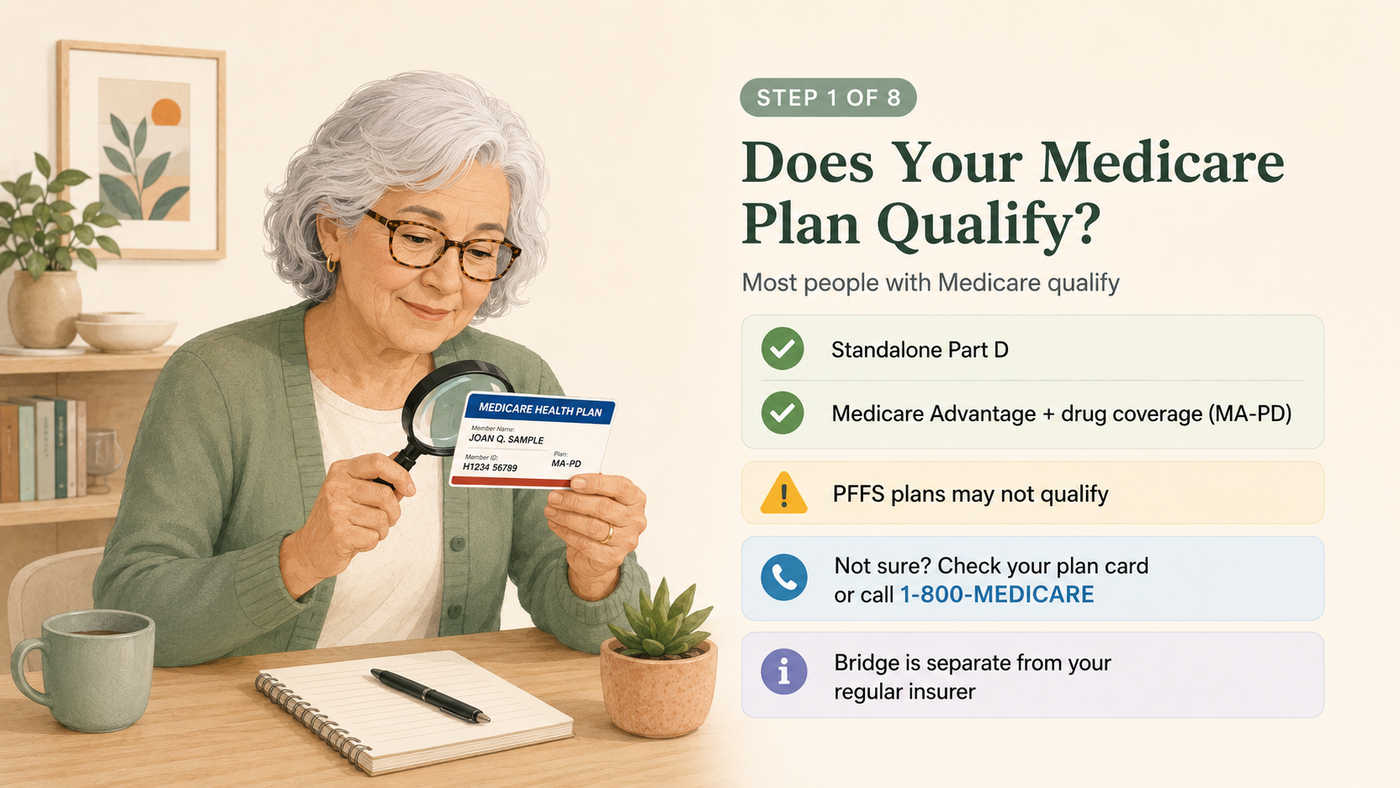
Most Part D plan types qualify for the Bridge. But the plan is only one check: the clinical criteria in Step 2 are strict, and you must meet all of them.
If you have a standalone Part D plan or Medicare Advantage that includes drug coverage, your plan type is eligible for the Bridge (eligible plans: Standalone Part D (PDP), Medicare Advantage with drug coverage (MA-PD), Special Needs Plans, employer group (EGWP) plans and LI NET). If you're not sure whether your Medicare Advantage plan includes drug coverage, check your plan card — it should say "Medicare Advantage Prescription Drug Plan" or "MA-PD." You can also call 1-800-MEDICARE (1-800-633-4227) to confirm.
A small number of plan types don't qualify — Private Fee-for-Service (PFFS), cost, HCPP, PACE, fallback and religious fraternal benefit plans — unless you also have a standalone Part D plan.
One important thing to know: the Bridge is a separate program run by CMS, which uses Humana (CMS’s central processor for the Bridge) for prior authorizations, claims and pharmacy payment. Your own Part D plan doesn't pay Bridge claims and doesn't need to opt in. You'd still contact your plan about Part D-coverable uses of a GLP-1, formulary exceptions and Part D appeals; for general Bridge questions, call 1-800-MEDICARE (1-800-633-4227).
(Source: CMS Medicare GLP-1 Bridge — Information for Pharmacies, June 2026)
STEP 2 OF 8
Do You Meet the Clinical Criteria?
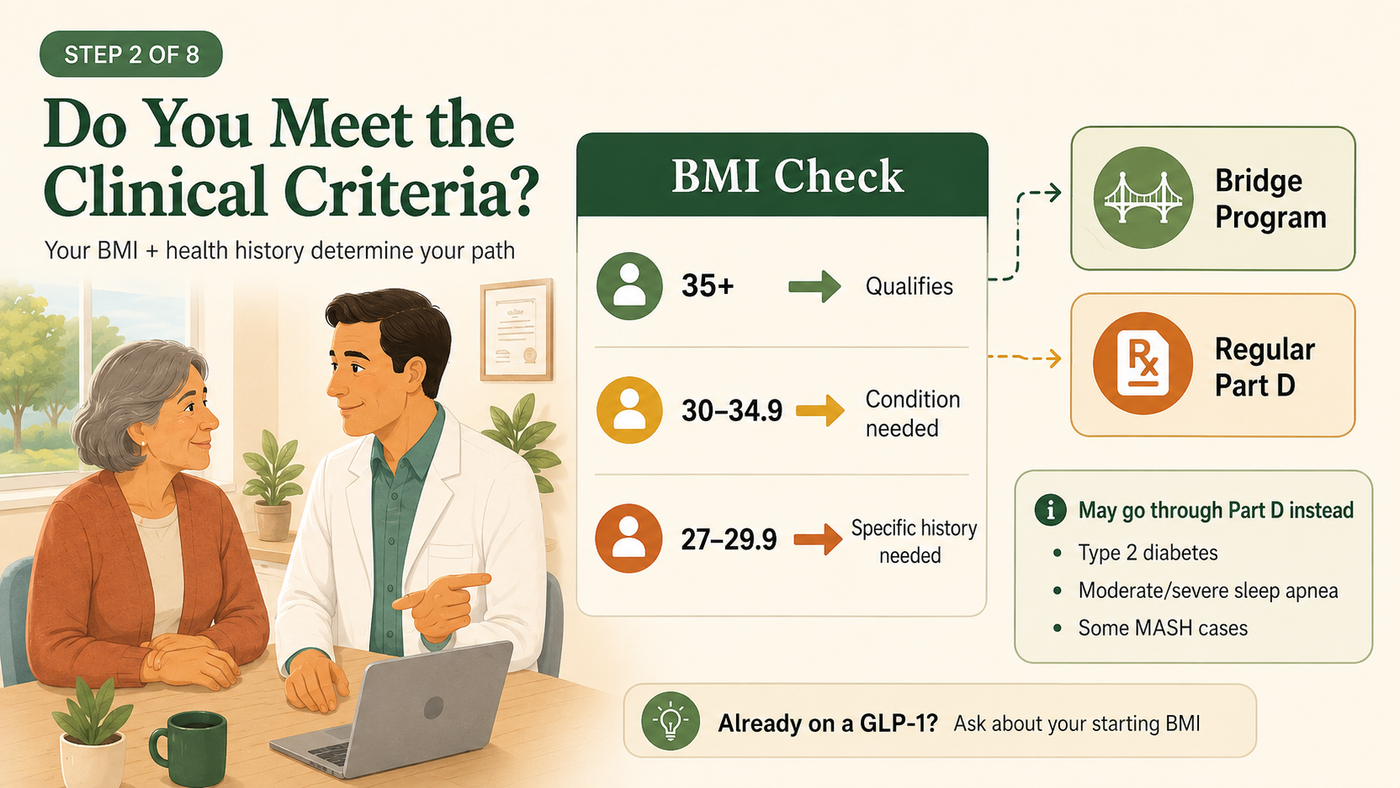
The Bridge has specific eligibility requirements based on your BMI and, in some cases, other health conditions. Here's how it works.
If you've already taken a GLP-1 and lost weight, your doctor may use your BMI from when you first started treatment — not just your BMI today. Ask your doctor to document your BMI at the time you first began treatment.
| Your BMI (or starting BMI if on a GLP-1) | What's required |
|---|---|
| 35 or above | No added condition — you meet the BMI tier (plan type, prior use, exclusions, purpose and prior authorization still apply) |
| 30–34.9 | One of: heart failure with preserved ejection fraction (HFpEF), uncontrolled high blood pressure on two medications, or chronic kidney disease stage 3a or above |
| 27–29.9 | One of: pre-diabetes, prior heart attack, prior stroke, or symptomatic peripheral artery disease |
What if I have Type 2 diabetes?
If you've been diagnosed with Type 2 diabetes, you can't use the Bridge — even if your Part D plan doesn't cover a GLP-1 for you. Instead, ask about a GLP-1 such as Mounjaro or Ozempic through your regular Medicare Part D plan, where it may be covered for diabetes, subject to the plan's formulary, prior authorization and exceptions process. We cover that path in Step 8.
What if I have sleep apnea?
It depends. If you've been diagnosed with moderate-to-severe obstructive sleep apnea, you can't use the Bridge. Zepbound has an FDA indication for that. Your Part D plan may cover Zepbound for moderate-to-severe sleep apnea, usually with prior authorization (subject to its formulary and exceptions process). Mild sleep apnea is not one of CMS's stated exclusions, but you must meet every other Bridge requirement.
What if I have MASH or NASH?
If you've been diagnosed with noncirrhotic MASH with moderate-to-advanced liver fibrosis (F2–F3), you can't use the Bridge. Wegovy has an FDA indication for that type of MASH, and it may be covered under your Part D plan for it, subject to the plan's formulary, prior authorization and exceptions process.
What if I have cardiovascular or heart disease?
It depends on your specific situation — having a history of heart attack or stroke can actually help you qualify for the Bridge at a lower BMI. But a GLP-1 prescribed to reduce the risk of cardiovascular events goes to Part D, not the Bridge, where it may be covered subject to the plan's formulary, prior authorization and exceptions process. Your doctor can help evaluate which path applies to you.
Additional requirements:
- Age 18 or older
- Prescribed for weight reduction (not another indication)
- Prescriber attests to ongoing lifestyle modification (structured nutrition and physical activity, unless physical activity isn't clinically appropriate)
- Your Part D plan hasn't paid for a GLP-1 for you at any time in calendar year 2026 (CMS hasn't set the 2027 lookback)
- Your prescriber gets prior authorization from the Bridge
(Source: CMS Medicare GLP-1 Bridge — Information for Prescribers, June 2026)
STEP 3 OF 8
Know Which GLP-1s the Bridge Covers
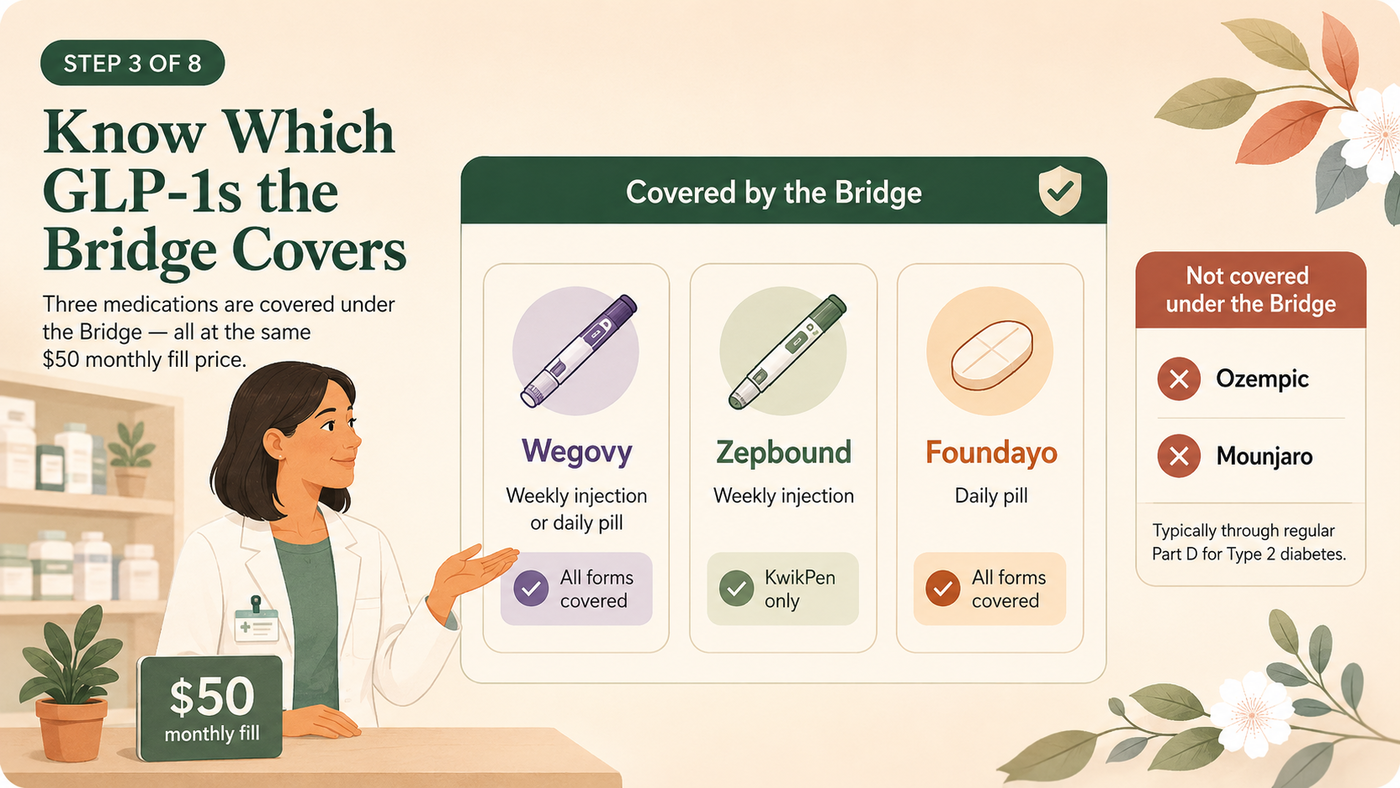
Your doctor will help decide which medication is appropriate, but it helps to know which forms are covered. The Bridge covers three medications — at any dose — for the same $50 monthly fill price.
GLP-1s Covered Under the Bridge
| Drug | Form | Notes |
|---|---|---|
| Wegovy (semaglutide) | Weekly injection or daily pill | All CMS-listed formulations are covered; CMS may update the list |
| Zepbound (tirzepatide) | Weekly injection | KwikPen only — vials and single-dose pens not covered |
| Foundayo (orforglipron) | Daily pill (no food/water restrictions, per Lilly) | Covered at any dose; FDA-approved April 1, 2026 |
What about Ozempic or Mounjaro?
Ozempic and Mounjaro are GLP-1 medications too, but they're not covered under the Bridge. They're prescribed primarily for Type 2 diabetes and may be covered under regular Medicare Part D for that use, subject to the plan's formulary, prior authorization and exceptions process. If you're on one of these and looking to access the Bridge, talk to your doctor about whether Wegovy, Zepbound, or Foundayo might be right for you. Keep in mind that a type 2 diabetes diagnosis rules out the Bridge.
(Source: CMS Medicare GLP-1 Bridge — Information for Pharmacies, June 2026)
STEP 4 OF 8
Talk to Your Doctor
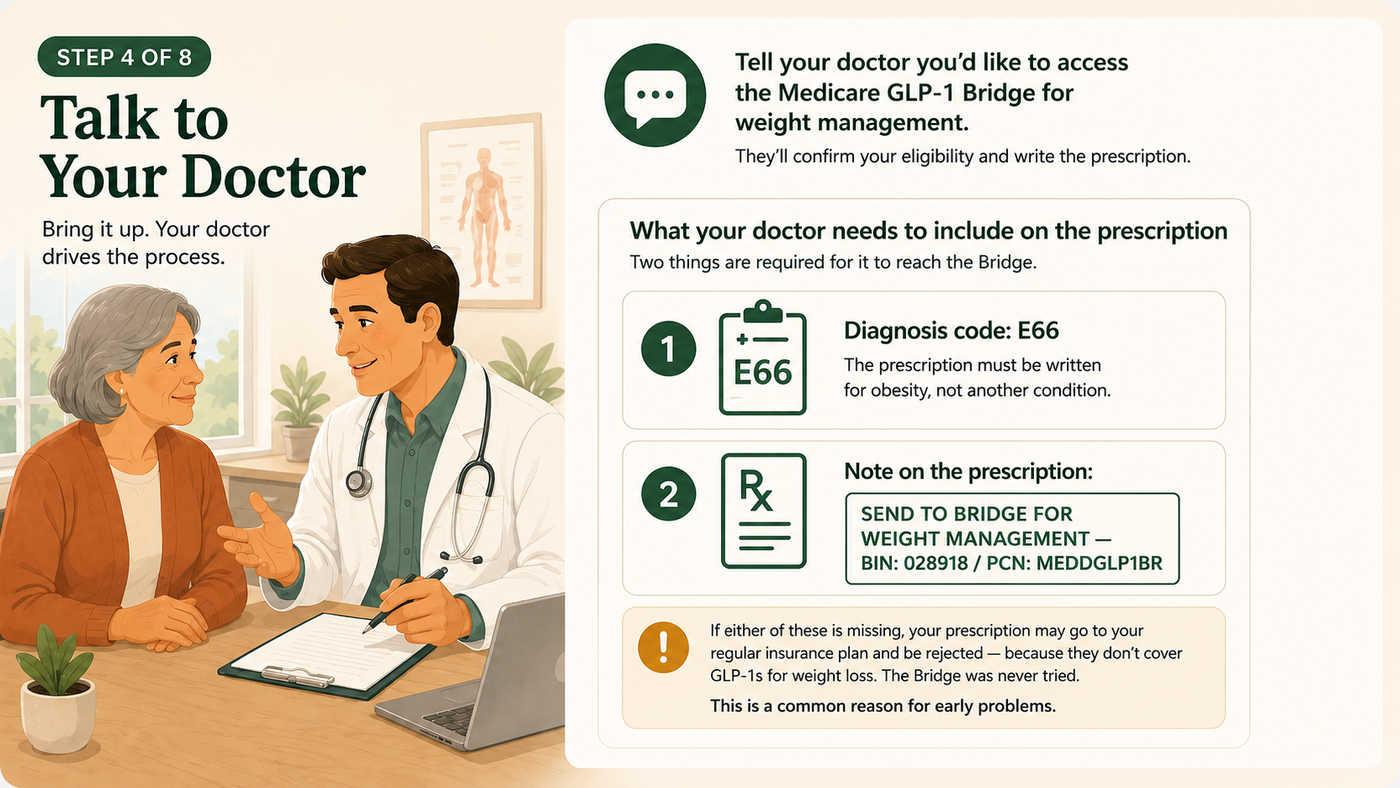
Once you've confirmed you're likely eligible, the next step is a conversation with your doctor. Your doctor drives this process — your job is to bring it up and make sure they have what they need.
Tell your doctor you'd like to access the Medicare GLP-1 Bridge for weight management. From there, they'll confirm your eligibility and write the prescription.
What your doctor needs to include on the prescription
This is the most important thing to know before your appointment: how the prescription is written helps it reach the Bridge. CMS recommends (but does not require) two things:
- Diagnosis code: E66 — this is the obesity diagnosis code. (The drug itself must be prescribed for weight reduction, not another condition.)
- A note on the prescription that says:
"SEND TO BRIDGE FOR WEIGHT MANAGEMENT"
The pharmacy then sends the claim to the Bridge's own billing codes (BIN 028918 / PCN MEDDGLP1BR). Those are for the pharmacy; your doctor doesn't need to write them on the prescription.
If the claim isn't sent to the Bridge, it may go to your regular Part D plan instead — and your plan may reject it (basic Part D excludes drugs used for weight loss) or start its own prior authorization. It'll look like a denial, but the Bridge wasn't actually tried. You don't need a Part D denial before using the Bridge.
Your doctor will also need to submit a prior authorization on your behalf. We cover what to expect from that process in Step 5.
(Source: CMS Medicare GLP-1 Bridge hub, June 2026)
STEP 5 OF 8
What Happens Next — The Prior Authorization Process
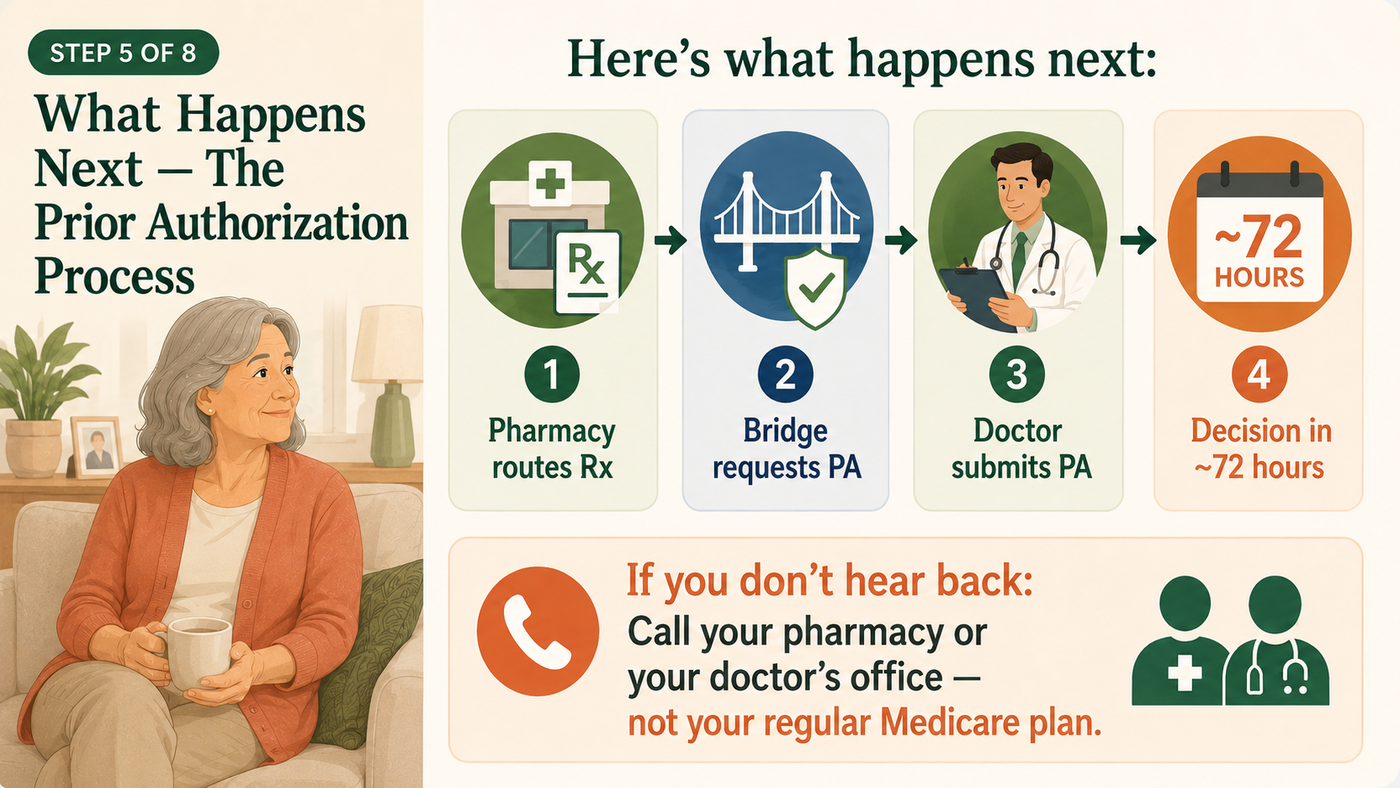
Once your doctor sends the prescription to the pharmacy, things move largely without you. Here's what's happening behind the scenes.
Your pharmacy sends a claim to the Bridge, which checks your eligibility. If you're eligible, the Bridge replies that a prior authorization (PA) is needed, and the pharmacy sends the PA request to your doctor (typically within 24–72 hours). Your doctor fills out and submits the PA form (electronically, e.g. through CoverMyMeds, or by fax) — the decision comes within 72 hours of submission: it is mailed to you and sent to your prescriber (through the ePA portal or by fax). Your doctor can't submit the PA before the pharmacy has sent a claim to the Bridge; if no request arrives within 72 hours, your prescriber can download the CMS form and submit it.
You can review the PA form your doctor will be filling out here: Medicare GLP-1 Bridge Prior Authorization Form (CMS). It's worth looking at so you understand what information your doctor needs to provide on your behalf.
Your job at this stage is mostly to wait.
But if a few days pass and you haven't heard anything, here's who to contact:
- Your pharmacy — ask if the prescription was routed to the Bridge and what the PA status is
- Your doctor's office — ask if the PA has been submitted and whether they've received a decision. Prescribers can call the Bridge's prescriber help line at 855-273-0102 (for prescribers) (Monday–Friday, 8am–7pm ET) about a PA's status; it isn't a patient line.
One thing worth repeating: your regular Part D plan doesn't pay Bridge claims, so it isn't the place to check a Bridge PA. For general Bridge questions, call 1-800-MEDICARE (1-800-633-4227). Contact your plan for Part D-coverable uses of a GLP-1, formulary exceptions and Part D appeals.
STEP 6 OF 8
You're Approved — Here's What to Expect
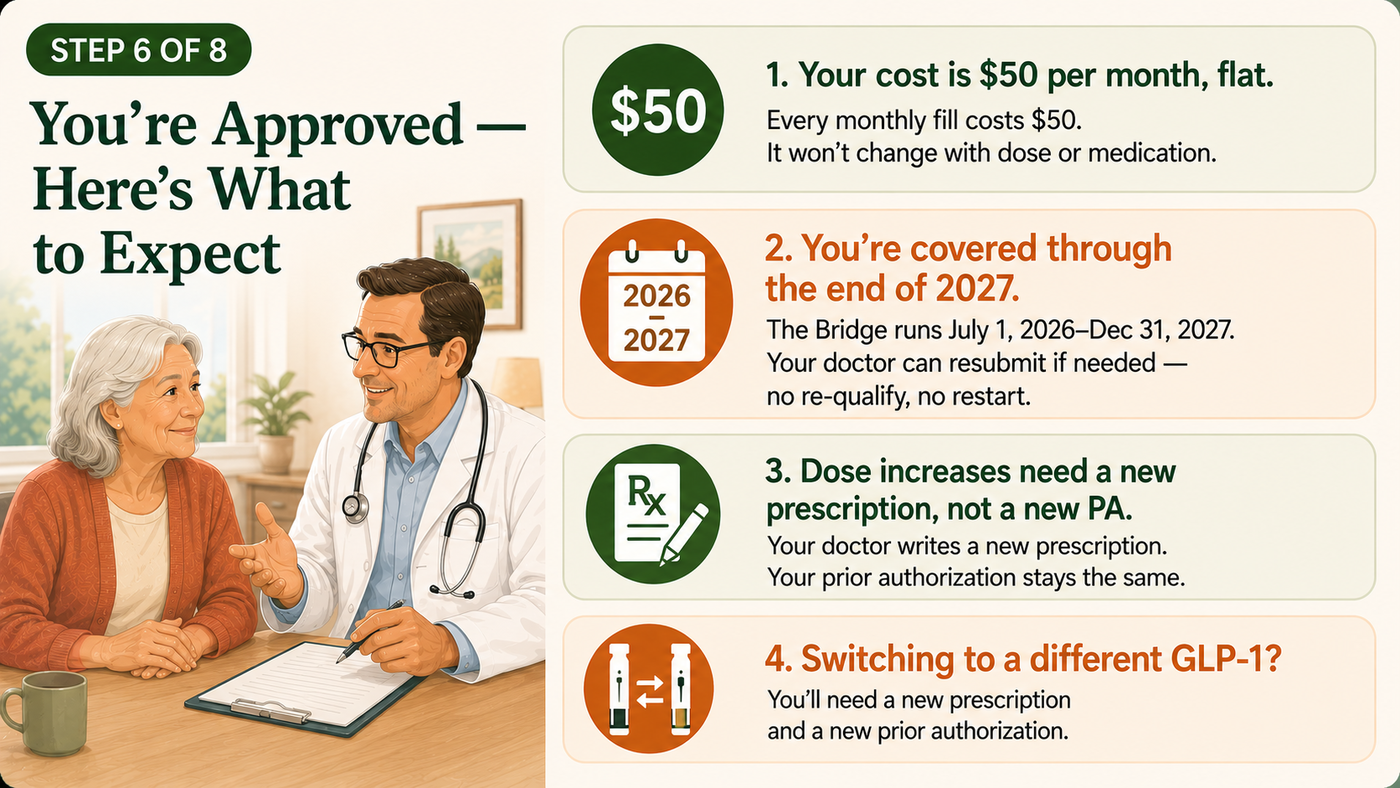
Good news — once you're approved, things get pretty straightforward.
Your cost is $50 per monthly fill, at any dose — and Extra Help or coupons can't lower it.
Every monthly fill costs $50, regardless of which medication you're on or what dose you're at. The $50 is fixed and doesn't count toward Medicare Part D's deductible or out-of-pocket cap — but it also won't change. GLP-1 doses typically increase over time while your body adjusts; your copay stays the same whether you're on the starter dose or the maintenance dose.
You're covered through the end of 2027.
The Bridge program runs from July 1, 2026 through December 31, 2027. That's up to 18 monthly fills if you're continuously eligible from July 2026. Bridge approvals are valid through December 31, 2027, so you don't need to re-qualify during the program. Fills are one month (28 or 30 days) at a time; 60- or 90-day supplies aren't available. Your approval stops working if you later fill a GLP-1 through your Part D plan or switch to a plan type that doesn't qualify.
As your dose increases, your doctor will write a new prescription — but you won't need a new prior authorization.
These drugs are labelled to start at a low dose and step up over several months. Each time your dose changes, your doctor issues a new prescription. That's normal. Your prior authorization carries over — CMS says fills after the first approved fill need no new PA unless you switch drugs.
If you switch to a different GLP-1, you'll need a new prescription and a new prior authorization.
Switching from Zepbound to Wegovy — or to any other covered drug — requires a new PA. If you ever need to switch (side effects, preference, shortage), expect a restart on the paperwork.
(Source: CMS Medicare GLP-1 Bridge — Information for Prescribers, June 2026; CMS — Information for Pharmacies)
STEP 7 OF 8
What to Do If You're Not Approved
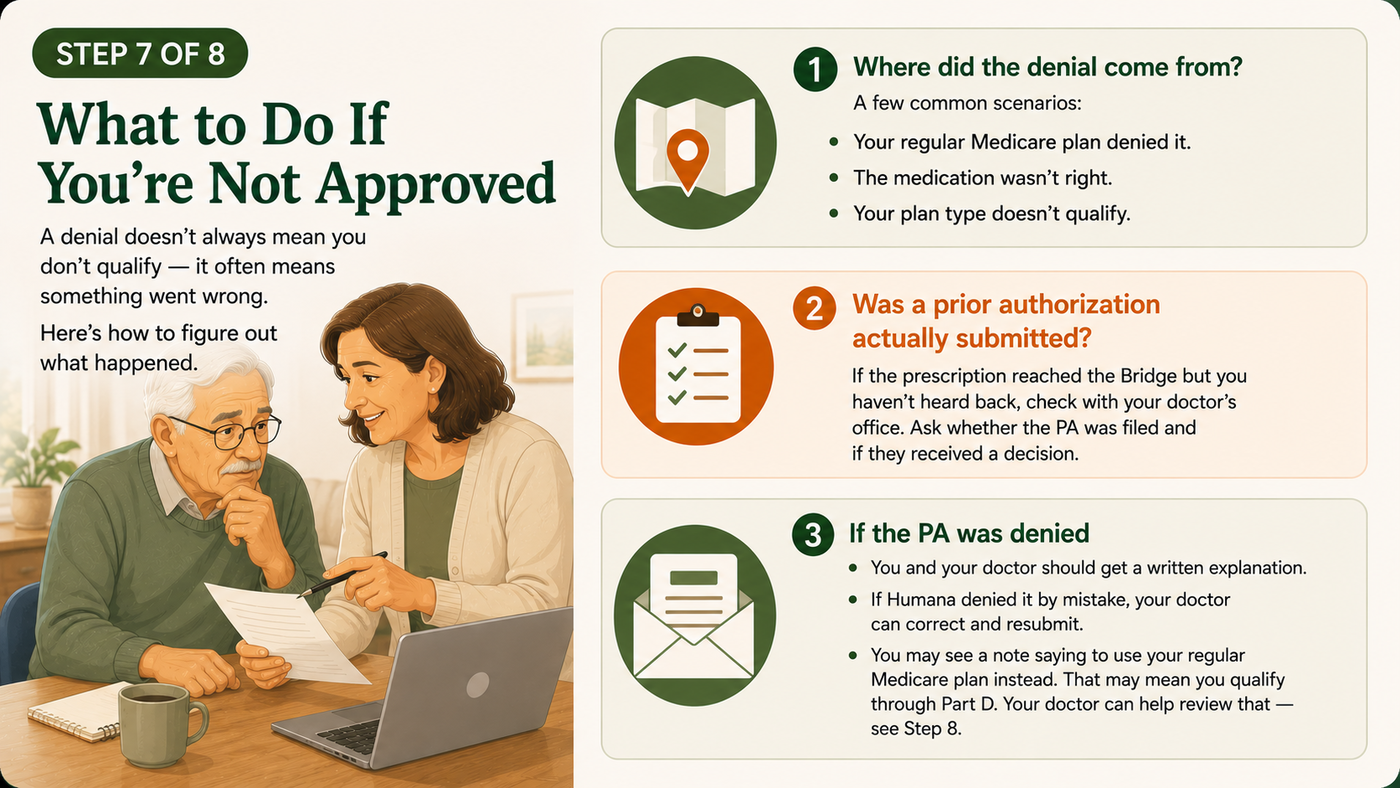
A rejection doesn't necessarily mean you don't qualify — it can also come from a problem in the process, such as the claim going to the wrong place or the wrong drug form. Here's how to figure out what happened.
Where did the denial come from?
Start here. A few common scenarios:
- Your regular Medicare plan denied it. This points to a routing problem — your Part D plan doesn't pay or decide Bridge claims, so if the rejection came from your plan, the claim likely went to Part D instead of the Bridge. Go back to your doctor and ask them to rewrite it with the Bridge routing CMS recommends (E66 diagnosis code and the Bridge note).
- The medication wasn't right. If the prescription was for a drug or form not covered by the Bridge — like Zepbound vials instead of the KwikPen, or Ozempic/Mounjaro — it would be denied. A new prescription with the correct medication is the fix.
- Your plan type doesn't qualify. A small number of Medicare plan types aren't eligible for the Bridge. If that's the case, Step 8 covers your other options.
Was a prior authorization actually submitted?
If the prescription reached the Bridge but you haven't heard back, check with your doctor's office. Ask whether the PA was filed and whether they received a decision — sometimes it simply wasn't submitted.
If the PA was denied
Both you and your doctor should receive a written explanation — read it carefully. There is no appeals process for a Bridge prior-authorization denial: your prescriber can resubmit the prior authorization with corrected or added information. This applies to the Bridge PA only — if a GLP-1 claim goes through your Part D plan and is denied, your normal Part D appeal rights still apply (a redetermination request within 65 days from the date on the denial notice).
One thing you may see: a note saying you should pursue coverage through your regular Medicare plan instead. That can mean the review found a reason you should get a GLP-1 through Part D instead — for example a type 2 diabetes diagnosis, or a prescription written to reduce cardiovascular risk. Your doctor can help evaluate whether that applies, and we cover those options in Step 8.
(Source: CMS Medicare GLP-1 Bridge — Information for Prescribers, June 2026)
STEP 8 OF 8
If You're Not Eligible for the Bridge
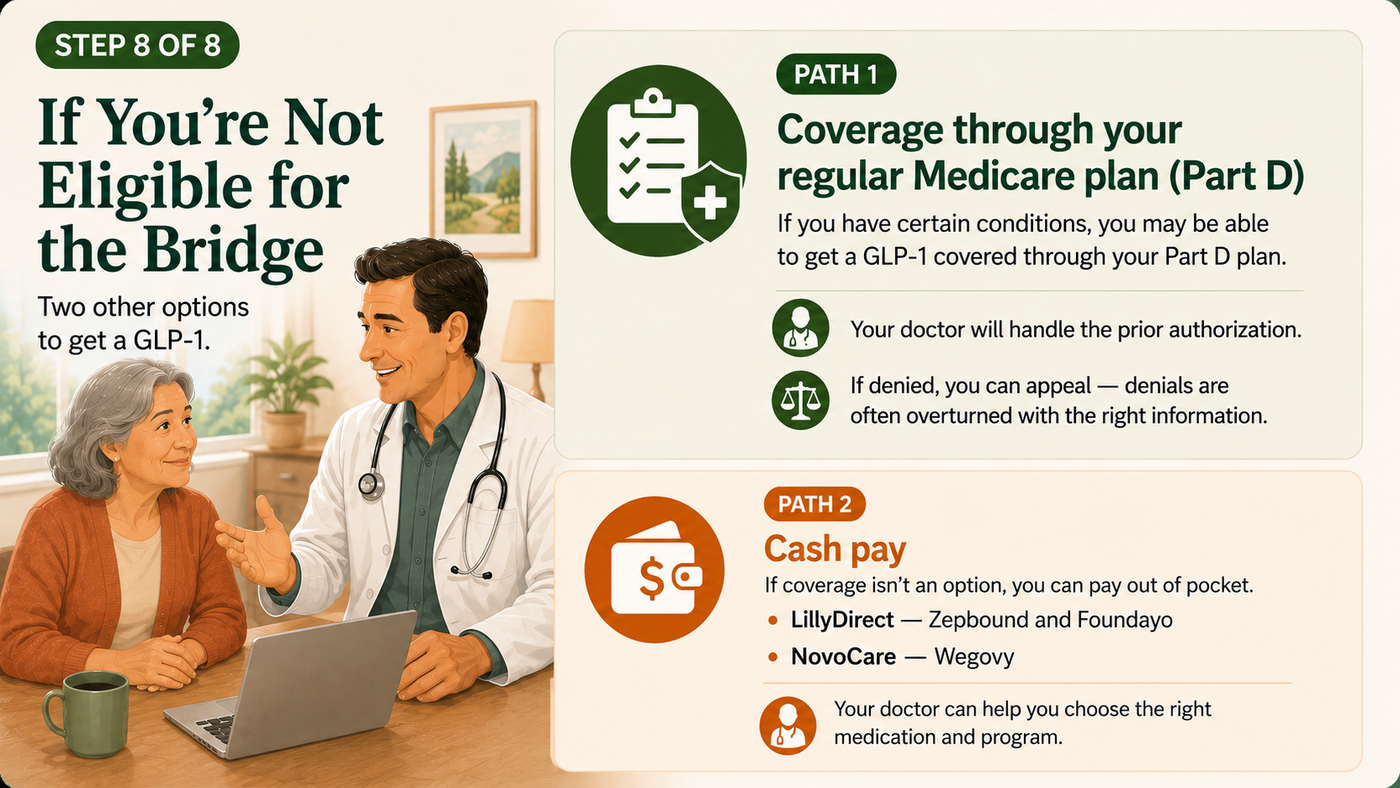
The Bridge isn't the only path to a GLP-1. If you don't qualify — or if you've been routed out of the Bridge — there are two other options worth knowing about.
Path 1: Coverage through your regular Medicare plan (Part D)
If you have Type 2 diabetes, moderate-to-severe sleep apnea, or certain other conditions, a GLP-1 may be covered under your regular Part D plan, subject to the plan's formulary, prior authorization and exceptions process.
Your doctor will need to submit a prior authorization through your plan. If it's denied, you have the right to appeal: Ask your plan for a redetermination within 65 days from the date on the denial notice; then ask for an independent review within 60 days after you receive the redetermination decision. Honest Care helps patients navigate this process.
Path 2: Cash pay
If coverage isn't an option, some patients choose to pay out of pocket. Two manufacturer direct programs are worth knowing about:
- LillyDirect — Eli Lilly's direct pharmacy program, which offers Zepbound and Foundayo at cash prices.
- NovoCare — Novo Nordisk's savings program, which offers self-pay pricing for Wegovy: $349/month for 0.25–2.4 mg pens (new self-pay patients: $199/month for the first two fills (0.25 mg and 0.5 mg), through December 31, 2026; $399 for Wegovy HD 7.2 mg), and $149–$299/month for tablets, by dose. NovoCare says government-insured patients may use the program "if they self pay and process outside of their insurance." Self-pay purchases don't count toward your Part D out-of-pocket costs.
Your doctor can help you decide which medication makes sense and point you toward the right program.
(Source: CMS Medicare GLP-1 Bridge — Information for Prescribers, June 2026)
CONTACT US
Have Questions or Need Help?
Navigating the Medicare GLP-1 Bridge can be confusing, and every situation is a little different. If you have questions about your specific case, reach out to us directly at medicarebridge@findhonestcare.com — we read every message.
If you've been denied a GLP-1 and want help fighting it, Honest Care's appeals service is built for exactly that. Since 2025 we've helped more than 10,000 people navigate GLP-1 coverage.
GOOD TO KNOW
Is the $50 Bridge Really Your Cheapest Option?
On price alone, the $50 Bridge copay is lower than every cash-pay option in the table below. But there is one scenario where the Bridge math can work against you, and it is worth understanding before you decide.
| Option | Monthly patient cost | Counts toward OOP cap? | Notes |
|---|---|---|---|
| Medicare GLP-1 Bridge | $50 | No | Available July 1, 2026 – December 31, 2027 |
| LillyDirect (Zepbound vials, cash) | $299–$449 | No | Requires self-injection with syringe; not covered under the Bridge |
| NovoCare self-pay (Wegovy) | Pens: $349 (intro offer: $199/month for the first two fills (0.25 mg and 0.5 mg), through December 31, 2026; Wegovy HD 7.2 mg $399). Tablets: $149–$299 by dose | No | NovoCare says government-insured patients may use self-pay "if they self pay and process outside of their insurance." It doesn't count toward your Part D out-of-pocket costs. The Wegovy savings card is for commercial insurance only. |
| Part D (if covered indication) | Plan cost-sharing (varies by plan) | Yes | Counts toward $2,100/$2,400 annual cap |
| Zepbound list price (no coverage) | about $1,086/month | No | — |
If you're a high-utilizer with multiple expensive medications, consider this:
The $50 Bridge copay doesn't count toward your $2,100 annual out-of-pocket cap. If you would otherwise hit that cap through normal Part D by mid-year — meaning your covered Part D drugs cost $0 for the rest of the year — then staying on a Part D-covered indication and letting your GLP-1 costs count toward your cap could leave you better off financially by December. This scenario requires having a covered Part D indication and high spending on other medications. In practice it only applies when a GLP-1 is prescribed to reduce cardiovascular risk, and CMS sends those prescriptions to Part D rather than the Bridge; a diagnosis of type 2 diabetes, moderate-to-severe obstructive sleep apnea or noncirrhotic MASH with moderate-to-advanced fibrosis already rules out the Bridge. It is worth discussing with a Medicare counselor or your prescriber.
The Bridge isn't the lower-cost choice in every situation. Check the math for your own case before you decide.
(Source: KFF — What Medicare's Temporary Program Covering GLP-1s for Obesity Means for Beneficiaries, March 2026; CMS Medicare GLP-1 Bridge — Information for Pharmacies, June 2026)
GOOD TO KNOW
What Happens to Your Coverage After December 31, 2027?
The Bridge ends December 31, 2027. No successor program has been confirmed.
If nothing changes, coverage ends and patients currently on Bridge GLP-1s will need a new plan.
The BALANCE Model — designed as the Medicare follow-on to the Bridge, under which Part D plans would voluntarily cover GLP-1s for obesity — has been delayed by CMS in Part D, and CMS has not set a new start date. The Bridge was extended through 2027 to cover the gap, and CMS has not announced what replaces it after December 31, 2027.
There's a deeper reason this is temporary: by law, basic Medicare Part D coverage excludes drugs used for weight loss. The Bridge is a temporary CMS demonstration, not a permanent benefit — and making Medicare GLP-1 coverage for obesity permanent would likely require a change in federal law.
GLP-1 benefits depend on staying on the medication.
In clinical trials, people who stopped these drugs regained much of the weight they'd lost — in the STEP 1 extension, about two-thirds of it within a year of stopping semaglutide (Wilding et al., 2022). So losing coverage at the end of 2027 isn't just a financial inconvenience — it can have real health consequences. Whether the Bridge will be extended or replaced before December 2027 is not yet known.
We will update this section as soon as CMS publishes guidance on what comes next.
(Source: KFF — What to Know About the BALANCE Model, May 2026; CMS Medicare GLP-1 Bridge hub, June 2026; Applied Policy — CMS Drug Pricing Models Encounter Delays, April 2026; STEP 1 trial extension — weight regain after stopping semaglutide (Wilding et al., 2022); SURMOUNT-4 — tirzepatide withdrawal (JAMA, 2024))
MEDICARE GLP-1 BRIDGE
Frequently Asked Questions
The Medicare GLP-1 Bridge is a real, CMS-run federal program — not a scam. It launched July 1, 2026 and runs through December 31, 2027. CMS announced it officially in May 2026, and Medicare.gov, CMS.gov, KFF, NCOA, and major news outlets have all covered it. Eligibility is strict, but the $50 copay is genuine for qualifying beneficiaries.
(Source: CMS press release, May 2026)
No. There is no enrollment process for the Bridge. You don't call Medicare, fill out a sign-up form, or do anything proactively. It starts with your prescription: The pharmacy sends the claim to the Bridge first; the Bridge then asks for a prior authorization, and the pharmacy sends the request to your prescriber, typically within 24–72 hours. Your prescriber submits the prior authorization, and coverage starts once it is approved. Start by talking to your doctor; you may also need to give the pharmacy your Medicare number and respond to pharmacy or prescriber requests.
(Source: CMS Medicare GLP-1 Bridge — Information for Pharmacies, June 2026)
No. Part D plans and pharmacies don’t opt in, and you don’t enroll separately; your prescriber must get prior authorization. Eligible beneficiaries in any qualifying plan type can access the Bridge regardless of whether their specific plan has taken any action. Your plan bears no financial risk for Bridge drugs — CMS handles all Bridge payments directly through the central processor.
(Source: CMS Medicare GLP-1 Bridge hub, June 2026)
Start by confirming these things: (1) you have an eligible plan type (most Part D plan types qualify — not PFFS, PACE, or a few other excluded types); (2) you are 18 or older and meet one of the three BMI tiers — BMI ≥35 on its own; BMI ≥30 with heart failure with preserved ejection fraction (HFpEF), uncontrolled high blood pressure (above 140/90 despite two medications), or chronic kidney disease stage 3a or above; or BMI ≥27 with prediabetes, a prior heart attack, a prior stroke, or symptomatic peripheral artery disease — based on your BMI when you first started GLP-1 therapy; (3) you have not been diagnosed with type 2 diabetes, moderate-to-severe obstructive sleep apnea, or noncirrhotic MASH with moderate-to-advanced fibrosis (F2–F3); (4) your Part D plan hasn't paid for a GLP-1 for you at any time in 2026; and (5) the drug is prescribed for weight reduction and your prescriber gets prior authorization. Your prescriber attests to the clinical facts; CMS's central processor (Humana) decides and may verify them. (Step 2 spells out each condition in plain language.)
(Source: CMS Medicare GLP-1 Bridge — Information for Prescribers, June 2026)
The Bridge covers three drugs: Wegovy (semaglutide) — all CMS-listed formulations, currently the injectable pen and oral tablet (CMS may update the list); Foundayo (orforglipron) tablets; and Zepbound (tirzepatide) KwikPen only. Zepbound single-dose vials and single-dose pens are explicitly not covered. Ozempic, Mounjaro, and Rybelsus are not Bridge drugs — those may be covered under Part D for their approved uses, subject to the plan's formulary, prior authorization and exceptions process.
(Source: CMS Medicare GLP-1 Bridge — Information for Pharmacies, June 2026)
Yes. Zepbound vials and single-dose pens are not covered under the Bridge. Only the Zepbound KwikPen is covered. The drug is the same (tirzepatide) at the same doses — the delivery device is the only difference. Ask your prescriber for a new KwikPen prescription. Without it, your Bridge claim will be rejected at the pharmacy before a prior authorization is even triggered. Pen needles for the KwikPen are not covered by the Bridge, so you buy them separately.
(Source: CMS Medicare GLP-1 Bridge — Information for Pharmacies, June 2026)
Yes — your cost is a flat $50 per monthly fill regardless of dose or drug. The Bridge central processor pays the pharmacy the wholesale acquisition cost minus your $50 copay, plus a $3 dispensing fee ($5 in long-term care) and any applicable sales tax. Separately, participating manufacturers provide Bridge drugs at a net program price of $245 per monthly supply; that is not what you pay. The $50 is the same on your first fill and your last fill, no matter what dose you're on.
(Source: CMS Medicare GLP-1 Bridge — Information for Pharmacies, June 2026; NCOA, June 2026)
No. If you receive Medicare Extra Help (the Part D Low-Income Subsidy), your LIS cost-sharing reduction does not apply to Bridge drugs. You pay the full $50 regardless of your Extra Help status. Beneficiaries who normally pay little or nothing per prescription through Extra Help will still pay $50 for Bridge GLP-1s — because the Bridge operates outside the Part D benefit structure entirely.
(Source: CMS Medicare GLP-1 Bridge — Information for Pharmacies, June 2026; KFF, March 2026)
No to both. The $50 Bridge copay does not count toward the 2026 Part D deductible (up to $615) or the 2026 annual out-of-pocket cap ($2,100). It will not count toward the 2027 cap ($2,400) either. Bridge spending is invisible to Part D's financial tracking because the Bridge operates outside the Part D benefit.
(Source: CMS Medicare GLP-1 Bridge — Information for Pharmacies, June 2026; KFF, March 2026)
Not if you've been diagnosed with type 2 diabetes or moderate-to-severe obstructive sleep apnea. People with type 2 diabetes, moderate-to-severe obstructive sleep apnea, or noncirrhotic MASH with moderate-to-advanced fibrosis (F2–F3) can't use the Bridge, even if their Part D plan doesn't cover a GLP-1 for that condition. You also can't use it if your Part D plan paid for a GLP-1 for you at any time in 2026. For those conditions, a GLP-1 may be covered under Part D, subject to the plan's formulary, prior authorization and exceptions process, with normal Part D appeal rights. Mild sleep apnea is not one of CMS's stated exclusions, but you must meet every other Bridge requirement. Talk with your doctor about which path applies.
(Source: CMS Medicare GLP-1 Bridge — Information for Prescribers, June 2026)
You may be. Eligibility is based on your BMI at the time you first started GLP-1 therapy, not your current BMI. If you started with a BMI of 37 and have since lost weight to 33, your prescriber attests to the 37 at initiation — you still meet the ≥35 tier. Ask your prescriber to document your BMI at the start of therapy before submitting a PA.
(Source: CMS Medicare GLP-1 Bridge — Information for Prescribers, June 2026)
On price alone, the $50 Bridge copay is lower than these cash-pay options. LillyDirect Zepbound vials run $299–$449/month. Wegovy self-pay through NovoCare is $349/month for 0.25–2.4 mg pens (new self-pay patients: $199/month for the first two fills (0.25 mg and 0.5 mg), through December 31, 2026; Wegovy HD 7.2 mg $399) and $149–$299/month for tablets, by dose. NovoCare says government-insured patients may use its self-pay program "if they self pay and process outside of their insurance"; self-pay purchases don't count toward your Part D out-of-pocket costs. Manufacturer savings cards are for commercial insurance only. The one exception: if you are a high-utilizer who would otherwise hit the $2,100 Part D OOP cap mid-year (making all your other drugs free for the rest of the year), the $50 Bridge copay — which doesn’t count toward that cap — could leave you worse off than using a covered Part D indication. Worth discussing with a counselor.
Not necessarily. Basic Part D excludes drugs used for weight loss, so a past Part D denial for weight-loss use may reflect that exclusion rather than whether you qualify medically. The Bridge is a separate path with its own criteria, so a past denial is a reason to check them, not to give up. (If your Part D plan paid for a GLP-1 for you at any time in 2026, you can't use the Bridge.)
First, identify which stage failed: (1) Was it routed to your Part D plan instead of the Bridge? Check whether the prescription had an E66 diagnosis code and the SEND TO BRIDGE FOR WEIGHT MANAGEMENT annotation (recommended by CMS, not required). (2) Did the Bridge eligibility check fail before a PA was triggered? Check the formulation (Zepbound must be KwikPen). (3) Was a PA submitted and denied on clinical grounds? There is no appeals process for a Bridge prior-authorization denial: your prescriber can resubmit it with corrected or added information. (If the claim went to your Part D plan and was denied there, normal Part D appeal rights apply.) Each stage has a different fix.
(Source: CMS Medicare GLP-1 Bridge — Information for Prescribers, June 2026)
CMS has not announced a successor. The Bridge ends December 31, 2027. The BALANCE Model in Part D — the planned follow-on — has been delayed, and CMS has not set a new start date. If no successor is enacted, coverage ends. Permanent coverage for obesity GLP-1s would likely require a change in federal law. We will update this page as soon as CMS publishes guidance.
(Source: KFF — BALANCE Model analysis, May 2026)
Other GLP-1 Medications on Medicare
Medicare coverage varies by medication. Compare your options:
References
- CMS Medicare GLP-1 Bridge — Information for Pharmacies (June 2026). cms.gov
- CMS Medicare GLP-1 Bridge — Information for Prescribers (June 2026). cms.gov
- CMS Medicare GLP-1 Bridge hub. cms.gov
- CMS Information for Medicare Beneficiaries. cms.gov
- KFF — What Medicare's Temporary Program Covering GLP-1s for Obesity Means for Beneficiaries. kff.org
- KFF — What to Know About the BALANCE Model for GLP-1s in Medicare and Medicaid. kff.org
- CMS press release — "Coming Soon: CMS to Provide $50 Monthly Access to GLP-1 Medications for Medicare Beneficiaries" (May 2026). cms.gov
- NCOA — Expanding Access to Weight Loss Medications: The Medicare GLP-1 Bridge Program (June 2026). ncoa.org
- Applied Policy — CMS Drug Pricing Models Encounter Delays and Resistance (April 2026). appliedpolicy.com
- FDA — First New Molecular Entity Approved Under the National Priority Voucher Program (Foundayo / orforglipron, April 1, 2026). fda.gov
- Eli Lilly — FDA Approves Foundayo (orforglipron) (April 1, 2026). investor.lilly.com
- KFF Health News — "A New Medicare Option for Weight Loss Drugs: What Older Americans Should Know" (Jackie Fortier, May 2026). kffhealthnews.org
- Wilding JPH et al. — Weight regain after withdrawal of semaglutide (STEP 1 trial extension) (Diabetes Obes Metab, 2022). pmc.ncbi.nlm.nih.gov
- Aronne LJ et al. — SURMOUNT-4: continued tirzepatide for maintenance of weight reduction (JAMA, 2024). jamanetwork.com
- Congressional Budget Office — How Would Authorizing Medicare to Cover Anti-Obesity Medications Affect the Federal Budget? (October 2024; estimates about 12.5 million beneficiaries would be eligible in 2026 under the proposed coverage policy). cbo.gov
- FDA — Approval of Zepbound (tirzepatide) for moderate-to-severe obstructive sleep apnea in adults with obesity (December 2024). fda.gov
About the Author
Sujatha Jamwal, Patient Support Lead at Honest Care
Sujatha works directly with Honest Care patients navigating insurance denials and GLP-1 access. She is passionate about making the healthcare system easier to navigate. The patterns in this guide come from that work — Honest Care has helped more than 10,000 people with GLP-1 coverage since 2025.
A note on what this is, and isn't: this is coverage information, not medical advice. Whether a GLP-1 medication is right for you is a decision between you and your doctor.
Disclaimer
The information on this page is for educational and informational purposes only and is not intended as medical advice. Honest Care does not provide medical diagnosis, treatment, or individualized recommendations. Always seek the advice of your physician or other qualified healthcare professional regarding any medical condition or treatment.
While this content has been reviewed for accuracy and balance, new evidence may emerge after publication. Drug availability, indications, and insurance coverage can change over time. Honest Care makes no warranties as to completeness or currentness of the information and is not responsible for decisions made based on this content.