
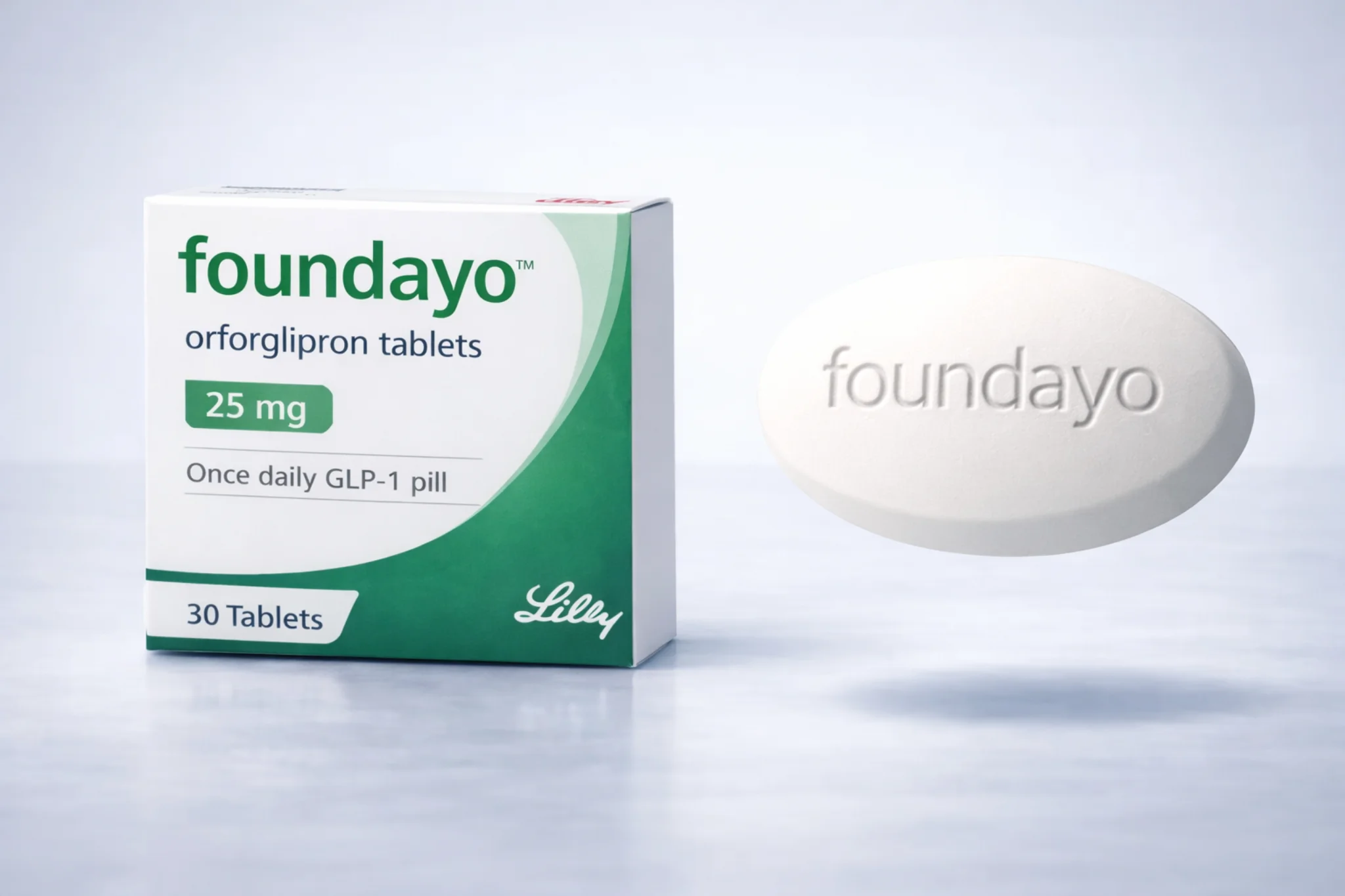
New Drug — Policies Still Developing
Foundayo was FDA approved April 1, 2026. Specific insurer step therapy requirements are still being established. The information below reflects expected patterns based on how insurers handle other GLP-1 medications. Always verify current requirements with your specific plan.
Short answer: Step therapy requires trying cheaper weight loss medications before insurers approve Foundayo. Common requirements (based on GLP-1 patterns): phentermine (3 months), Contrave (3 months), or Wegovy (6 months). If you've already been denied, you can appeal with prior medication history or medical exceptions.
What is step therapy for Foundayo?
Step therapy (also called "fail first") means you must try and fail on alternative medications before your plan will cover Foundayo:
- Most GLP-1 step therapy requires 1-2 medications for 3-6 months each
- Common drugs: phentermine, Contrave, Qsymia, Wegovy
- Prior medication history may satisfy requirements without new trials
- 65%+ of GLP-1 appeals succeed with proper documentation[8]
Who this guide is for
Anyone trying to get Foundayo covered by insurance—whether you're just starting the approval process, you've been denied and want to appeal, or you're looking to skip step therapy because you've already tried other medications.
Your GLP-1 coverage,
denied approved
✓ Free Templates✓ Premium Support Available
I was denied coverage for...
Get starteddenied approved
Honest Care helps patients fight back:
Evidence-backed appeal letters — plus personalized guidance to appeal with confidence.
"I found Honest Care online and was very impressed with the letter... the appeal worked!"
"My Appeal was approved the next day. Thank you Honest Care!"
UNDERSTANDING THE BASICS
What Is Step Therapy?
Step therapy (also called "fail first") is an insurance requirement where you must try and fail on cheaper weight loss medications before your insurer will approve Foundayo. It's one of the most common barriers to GLP-1 coverage.[1]
The "Fail First" Rule
Step therapy requires you to try cheaper medications before your insurer will cover Foundayo. Even if your doctor prescribes Foundayo as the best option for you, insurers may deny it until you've "failed" other drugs first. This is primarily a cost-control measure—Foundayo's list price is higher than alternatives like phentermine ($15-30/month), though self-pay via LillyDirect is $149–$299/month depending on dose.
Does Your Insurer Require Step Therapy?
Requirements vary by insurer and plan. Aetna, for example, typically requires lifestyle documentation but not medication trials for GLP-1s. Check the insurer table below for expected patterns, and verify with your specific plan.
How Step Therapy Works
You Request Foundayo
Your doctor submits a prior authorization for Foundayo.
Insurer Denies (Step Therapy Required)
The insurer says you must try other medications first. Your denial letter lists which drugs qualify.
You Try Required Medications
You take the step therapy drugs for the required duration (usually 3-6 months each).
Document the Outcome
Your doctor documents that the step therapy drug was ineffective (didn't produce sufficient weight loss) or intolerable (caused side effects you couldn't manage).
Resubmit for Foundayo
With step therapy satisfied, your doctor resubmits the PA for Foundayo with documentation of prior trials.
The good news: Over 30 states have step therapy override laws that can help you skip these requirements. And with the right documentation, you can appeal successfully even without them.[4]
WHAT YOU MAY NEED TO TRY FIRST
Common Step Therapy Drugs
These are the most common medications insurers require before approving GLP-1s like Foundayo:
| Medication | Typical Trial Duration | Cost | Common Side Effects |
|---|---|---|---|
| Phentermine | 3 months | $15-30/mo | Increased heart rate, insomnia, dry mouth |
| Contrave (naltrexone/bupropion) | 3 months | $100-200/mo | Nausea, constipation, headache |
| Qsymia (phentermine/topiramate) | 3 months | $150-250/mo | Tingling, constipation, dry mouth |
| Saxenda (liraglutide) | 3-6 months | $1,000+/mo | GI issues (nausea, diarrhea) |
| Wegovy (semaglutide) | 6 months | $1,349/month* | GI issues, another GLP-1 (often preferred) |
*Injectable Wegovy list price. Oral Wegovy (approved Dec 2025) is $149–$299/month by dose via NovoCare—ask your insurer which formulation is required.
Wegovy May Be Required First
Based on GLP-1 coverage patterns, some insurers may require trying Wegovy for 6 months before approving Foundayo. If you don't respond well to Wegovy, that's strong documentation for Foundayo. Verify current requirements with your specific plan.
What Counts as "Failure"?
To satisfy step therapy, you need to document that the medication either:
- Didn't work — You took it for the required duration but achieved less than 5% weight loss
- Caused intolerable side effects — Side effects severe enough that you couldn't continue
- Is contraindicated — You have a medical condition that makes the drug unsafe (e.g., uncontrolled hypertension for phentermine)
EXPECTED REQUIREMENTS (APRIL 2026)
Step Therapy by Insurer
Step therapy requirements vary significantly by insurer. The following reflects expected patterns based on how insurers handle other GLP-1 medications. Foundayo-specific policies are still being established—always verify with your plan.
| Insurer | Expected Step Therapy? | Typical GLP-1 Requirements |
|---|---|---|
| Aetna | Typically no medication step therapy | Usually requires 6 months lifestyle modification only |
| UnitedHealthcare | Likely yes | May require trying preferred GLP-1 first |
| CVS Caremark | Likely yes | Some plans may require trying another drug first; check your plan’s criteria |
| Cigna | Varies by plan | May require phentermine, Contrave, or Wegovy |
| BCBS | Varies by affiliate | Varies widely—check your specific plan |
| Kaiser | Typically yes | Usually requires phentermine and/or Contrave |
Aetna Advantage
Based on GLP-1 patterns, Aetna typically requires no medication step therapy—just 6 months of documented lifestyle modification (diet and exercise). Verify this applies to Foundayo with your specific Aetna plan.
For complete PA requirements by insurer, see our detailed requirements guide.
VALID EXCEPTIONS
When You Can Skip Step Therapy
You may qualify for a step therapy exception if any of the following apply:
You've Already Tried It (And It Didn't Work)
If you've already taken the required medication in the past, you may not need to try it again. This applies if:
- You took it for 3+ months but didn't lose at least 5% of your body weight
- You initially lost weight but gained it back
- The medication simply didn't work for you
What you need: Pharmacy records showing when you filled the prescription, and doctor's notes showing your weight before and after
The Required Drug Isn't Safe for You
If you have a health condition that makes the step therapy drug unsafe, you can skip it. Common examples:
- Phentermine: Not safe if you have uncontrolled high blood pressure, heart disease, overactive thyroid, glaucoma, are pregnant, or take certain antidepressants (MAOIs)
- Orlistat: Not safe if you have digestive absorption problems or gallbladder issues
- Contrave: Not safe if you have seizures, eating disorders, take opioid pain medications, or have severe liver problems
- Qsymia: Not safe if you're pregnant or planning pregnancy, have glaucoma, or overactive thyroid
What you need: Medical records showing your condition that makes the drug unsafe for you
You Had Bad Side Effects
If you tried the medication before and couldn't tolerate it, you can skip it. Examples of side effects that qualify:
- Severe stomach problems like constant diarrhea or oily stools (orlistat)
- Racing heart or high blood pressure (phentermine)
- Confusion, memory problems, or seizures (Qsymia)
- Depression, severe anxiety, or thoughts of self-harm
What you need: Doctor's notes showing what side effects you had and why you stopped taking it
Your State Has Laws That Protect You
Over 30 states have laws that force insurers to skip step therapy when you have a valid reason:[4]
- The required drug isn't safe for you to take
- You've already tried it and it didn't work (or caused bad side effects)
- You're already stable on your current medication
- There's medical evidence that the step therapy drug isn't right for you
How fast must insurers respond: 72 hours normally, 24 hours if it's urgent
States with strong protections: California, New York, Texas, Illinois, Michigan, Ohio
You Have a Medical Reason to Start With Foundayo
Sometimes your doctor can argue that Foundayo is the right choice for you from the start:
- More effective: Foundayo helps people lose ~12% of body weight—more than older medications (3-10%)[9]
- You have other health conditions: If you have sleep apnea, heart disease, or diabetes, losing more weight faster may be medically necessary
- Your BMI is very high: If you need to lose a significant amount of weight, a more effective medication makes sense
- Easier to take: Unlike oral Wegovy (which requires a 30-minute fast), Foundayo can be taken any time with or without food
What you need: A letter from your doctor explaining why Foundayo is the right choice for your specific situation
denied approved
Honest Care helps patients fight back:
Evidence-backed appeal letters — plus personalized guidance to appeal with confidence.
FIGHTING BACK
How to Appeal a Step Therapy Denial
Step therapy denials can be appealed by documenting prior medication trials, contraindications, or adverse reactions. You have 180 days from your denial date to file.
Get Your Denial in Writing
Request written denial letter stating exactly which medications you must try first and for how long. Note your appeal deadline (typically 180 days).
Review Your Medication History
Check pharmacy records for prior weight loss medication trials. Note any side effects, contraindications, or ineffectiveness.
Identify Your Exception Argument
Choose your basis for appeal: prior failure, contraindication, adverse reaction, or state law protection.
Gather Documentation
Collect records of prior medication trials, side effect documentation, labs showing contraindications, BMI history, and comorbidities.
Submit Your Appeal
Work with your doctor to submit step therapy exception request, Letter of Medical Necessity, and supporting documentation via fax or certified mail.
Escalate If Denied
Request external review within 4 months (check your state). Independent reviewer decision is binding on insurer. 65%+ of GLP-1 appeals succeed with proper documentation.[8]
For the complete appeal process, see our Foundayo Appeals Guide.
TEMPLATE FOR STEP THERAPY APPEALS
Sample Appeal Language
Share This With Your Doctor
The template below is written for your doctor to submit on your behalf. Print it or share this page with your provider's office—they can customize it with your specific medical history.
View Step Therapy Appeal Template (For Your Doctor)
HEADER:
[Date]
[Medical Director Name]
[Insurance Company]
[Address]
Re: Step Therapy Exception Request for [Patient Name]
Member ID: [Number]
DOB: [Date]
Case/Reference ID: [Number]
OPENING:
"Dear Medical Director,
I am writing to request a step therapy exception for Foundayo (orforglipron) for [Patient Name]. The prior authorization was denied due to step therapy requirements. I respectfully request reconsideration based on the following clinical information demonstrating why step therapy should be waived."
EXCEPTION REASON (choose applicable):
If Prior Failure:
"[Patient Name] has previously tried [medication name] from [start date] to [end date] at [dose]. Despite adequate trial duration, the patient achieved only [X]% weight loss, below the clinically meaningful threshold of 5%. The medication was discontinued due to [inefficacy/side effects]. Documentation attached."
If Contraindication:
"[Patient Name] has a documented history of [condition], which is a contraindication to [required medication]. Specifically, [explain why the required medication cannot be safely used]. Per [guideline/prescribing information], [required medication] should not be used in patients with [condition]."
If Adverse Reaction:
"[Patient Name] previously tried [medication name] and experienced [specific adverse effects], which required discontinuation. These effects persisted despite dose adjustment and were intolerable for the patient. Given this documented intolerance, requiring a repeat trial would not be medically appropriate."
If State Law Applies:
"Pursuant to [State] step therapy override law [cite statute], [Patient Name] qualifies for a step therapy exception because [state specific qualifying reason]. This law requires the insurer to grant an exception within [72 hours/24 hours for urgent cases]."
CLINICAL JUSTIFICATION:
"Foundayo (orforglipron) is uniquely appropriate for [Patient Name] because:
- BMI of [X] kg/m2 with comorbidities including [list with ICD-10 codes]
- Clinical trials (ATTAIN-1) demonstrate ~12% weight loss with Foundayo vs. 3-10% with older medications
- Patient's [comorbidities/clinical situation] warrants more effective intervention
- Foundayo's oral formulation with no food restrictions improves likelihood of adherence"
CLOSING:
"Based on the above, requiring [Patient Name] to trial additional medications before Foundayo would delay necessary treatment for a serious chronic disease and is not supported by clinical evidence or applicable state law.
Please contact me at [phone] with any questions. I request an expedited response due to the patient's clinical need.
Sincerely,
[Provider Name, Credentials]
[NPI Number]"
Key Phrases for Step Therapy Appeals
| Situation | Effective Language |
|---|---|
| Prior medication failed | "Patient achieved only [X]% weight loss after [X] months of therapy, failing to meet the clinically meaningful threshold of 5%." |
| Side effects | "Patient experienced [specific effects] requiring discontinuation. A repeat trial would expose patient to known intolerable effects without reasonable expectation of benefit." |
| Contraindication | "Per FDA labeling, [medication] is contraindicated in patients with [condition]. Patient has documented [condition], making this medication medically inappropriate." |
| Clinical urgency | "Delay in effective treatment poses significant health risks given patient's BMI of [X] and comorbidities including [conditions]. Expedited review requested." |
Official resource: Provider resources including Letter of Medical Necessity templates may be available via Lilly's healthcare provider portal or by contacting Lilly directly at 1-800-545-5979.
IF YOU'VE TRIED THE DRUGS
Documenting Step Therapy Failure
If you've tried the required medications and they didn't work (or you couldn't tolerate them), here's how to document it properly:
Documentation Checklist
Include the exact formulation and dosage you took
Show you took it for the required duration (or explain why you stopped early)
Document that you didn't achieve meaningful weight loss (typically <5%)
Be specific: "severe nausea daily" not just "GI issues"
Clearly state why: ineffective, intolerable, or both
Sample Documentation Language
For Inefficacy
"Patient completed 90-day trial of phentermine 37.5mg daily from [DATE] to [DATE]. Starting weight: 245 lbs (BMI 38.2). Weight after trial: 240 lbs (BMI 37.4). Patient achieved only 2% weight loss despite medication compliance and concurrent lifestyle modification, which is below the 5% threshold indicating adequate response."
For Intolerance
"Patient initiated Contrave on [DATE] and discontinued after 6 weeks due to severe, persistent nausea (daily vomiting), insomnia (sleeping <4 hours/night), and headaches unresponsive to supportive care. These adverse effects significantly impaired quality of life and made continued therapy intolerable."
WHAT'S CHANGING
Step Therapy: 2026 Outlook
2026: Step Therapy Requirements May Evolve
More insurers are implementing step therapy for GLP-1 medications, often requiring trials of phentermine, Contrave, or Saxenda before approving newer options. However, self-pay options offer an alternative pathway.
LillyDirect: Skip Step Therapy Entirely
LillyDirect self-pay offers Foundayo for $149–$299/month depending on dose—no step therapy, no prior authorization, no documentation required.[7]
TrumpRx Program
TrumpRx.gov lists manufacturers’ own self-pay prices—bypassing insurance entirely. Launched February 5, 2026; Foundayo is listed at LillyDirect’s prices (starting dose $149/month), and orders go through LillyDirect.[10]
Longer Step Therapy Trials Expected
Some insurers may extend required trials from 3 months to 6 months per medication. Wegovy trials may require 6+ months before approving other GLP-1s.
State-Level Step Therapy Reform
Texas "Gold Carding": Providers with 90%+ approval rates bypass step therapy. California: Physicians can override step therapy with documented medical reason.[4]
What Should You Do Now?
- Document all prior medications NOW: Any weight loss medications you've tried could satisfy future requirements
- Start step therapy early if required: Completing it now means you're ready when you need coverage
- Consider self-pay as backup: At $149–$299/month via LillyDirect with no step therapy, this may be simpler than fighting stricter requirements
- Keep detailed records: Dates, doses, side effects, and weight outcomes for every medication tried
STEP THERAPY FOR FOUNDAYO
Frequently Asked Questions
Step therapy (also called "fail first") is an insurance requirement where you must try and fail on cheaper weight loss medications before your insurer will approve Foundayo. Common step therapy drugs include phentermine, Contrave, Qsymia, and increasingly Wegovy. Since Foundayo was just approved in April 2026, specific insurer policies are still being established.
Most step therapy drugs require a 3-month trial. However, Wegovy (which many insurers require for GLP-1s) typically needs a 6-month trial. If you've already tried these medications in the past, you may be able to skip this waiting period by providing documentation.
Yes. If you've previously tried step therapy drugs (even years ago or with a different insurer), that may count. Gather records showing: which medication, dates of treatment, why you stopped, and weight outcomes. Your doctor can submit a step therapy exception request with this documentation.
Many step therapy drugs have contraindications. For example, phentermine is contraindicated if you have uncontrolled high blood pressure or heart disease. If a step therapy drug is unsafe for you, your doctor can document the contraindication and request an exception.
Over 30 states have step therapy override laws that require insurers to grant exceptions under certain conditions—such as contraindication, prior failure, adverse reaction, or when the patient is stable on current therapy. These laws typically require insurers to respond within 72 hours (24 hours for urgent cases).
Based on Aetna's typical GLP-1 policies, they usually require no medication step therapy—only 6 months of documented lifestyle modification (diet and exercise). However, since Foundayo just launched, verify current requirements with your specific Aetna plan.
If you're currently taking Wegovy, you may have already satisfied step therapy requirements. Document how long you've been on it, your weight outcomes, and why switching to Foundayo is medically necessary (e.g., preference for no food restrictions, plateau in weight loss). Your doctor can include this in the PA request.
It depends on your insurer. Prior use of other GLP-1 medications (Mounjaro, Wegovy, Ozempic) may satisfy step therapy requirements since they're in the same drug class. Document your prior GLP-1 history—dates, doses, and outcomes—and have your doctor include this when requesting Foundayo. Since Foundayo policies are still being established, verify with your specific plan.
You typically have 180 days from your denial date to file an internal appeal. If your internal appeal is denied, you can request an external review within 4 months (some states allow longer). The external reviewer's decision is binding on your insurer.
YOUR PATH FORWARD
What's Next
Other Common Denial Reasons
Denied for a different reason? See our guides for other denial types:
- Medical Necessity Not Met — Insurer says treatment isn't needed
- BMI Criteria Not Met — Weight thresholds not satisfied
- Formulary Exclusion — Drug not on plan's covered list
- Missing Lifestyle Documentation — Diet/exercise records needed
Not sure why you were denied? View all Foundayo denial types
References
- American Medical Association. (2023). "2022 AMA Prior Authorization Physician Survey." ama-assn.org (PDF)
- GoodRx. (2025). "What is Step Therapy? How to Get Insurance to Pay for Your 'Non-Preferred' Drug." General step therapy resource. goodrx.com
- Cigna Healthcare. "Prior Authorization Coverage Policies — search for 'GLP-1 weight loss' criteria." General GLP-1 coverage resource. cigna.com
- Triage Cancer. (2025). "Health Insurance State Laws: Step Therapy." triagecancer.org
- Centers for Medicare & Medicaid Services. (2025). "CMS Interoperability and Prior Authorization Final Rule (CMS-0057-F)." cms.gov
- HealthCare.gov. "Internal Appeals." healthcare.gov
- Eli Lilly and Company. (2026). "Lilly's Foundayo (orforglipron) Receives FDA Approval for Chronic Weight Management." Investor News Release, April 1, 2026. investor.lilly.com
- American Medical Association. (2024). "Over 80% of Prior Auth Appeals Succeed—Why Aren't There More?" 81% of Medicare Advantage appeals succeed; we use a conservative 65%+ estimate for commercial insurance GLP-1 appeals. ama-assn.org
- Wharton S, et al. (2025). "Orforglipron for the Treatment of Obesity." N Engl J Med. September 2025. ATTAIN-1 trial showing ~12% weight loss at 72 weeks. DOI: 10.1056/NEJMoa2511774. pubmed.ncbi.nlm.nih.gov
- Reuters. (February 6, 2026). "TrumpRx has limited reach at launch beyond weight-loss drugs, experts say." reuters.com
Last updated October 6, 2026 · Key facts verified October 5, 2026
Disclaimer
The information on this page is for educational and informational purposes only and is not intended as medical advice. Honest Care does not provide medical diagnosis, treatment, or individualized recommendations. Always seek the advice of your physician or other qualified healthcare professional regarding any medical condition or treatment.
While this content has been reviewed for accuracy and balance, new evidence may emerge after publication. Drug availability, indications, and insurance coverage can change over time. Honest Care makes no warranties as to completeness or currentness of the information and is not responsible for decisions made based on this content.