
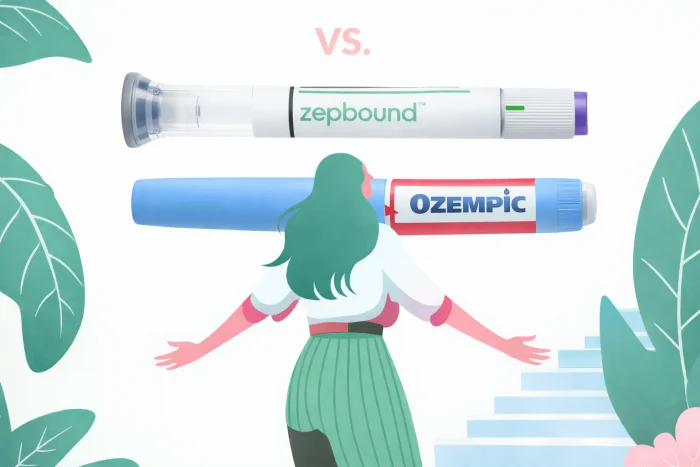
ZEPBOUND VS. OZEMPIC
Key Differences at a Glance
Bottom Line
Zepbound leads to 20-22% weight loss vs. 5-7% with Ozempic at diabetes doses (or ~14-15% with semaglutide at higher Wegovy doses). Zepbound works via dual hormone pathways (GIP + GLP-1 vs. GLP-1 only) and is FDA-approved for weight loss—while Ozempic is only approved for type 2 diabetes.[1]
| Feature | Zepbound | Ozempic |
|---|---|---|
| Active Ingredient | Tirzepatide | Semaglutide |
| Manufacturer | Eli Lilly | Novo Nordisk |
| FDA Approval | Weight management, Sleep apnea (OSA) | Type 2 diabetes, CV risk reduction, CKD (Jan 2025) |
| How It Works | Dual GIP/GLP-1 agonist | GLP-1 agonist only |
| Weight Loss | ~20-22% at max dose | ~5-7% (diabetes dose)* |
| Dosing | Weekly injection (2.5–15 mg) | Weekly injection (0.25–2 mg) |
| List Price | ~$1,086/month | ~$998/month |
| Insurance Coverage | Limited (weight loss exclusions common) | Good for diabetes, limited for weight loss |
*Semaglutide at higher Wegovy doses (2.4mg) achieves ~14-15% weight loss, but Ozempic's max dose is 2mg and is approved only for diabetes.
For a complete overview of Zepbound, see our Zepbound guide. To compare with other alternatives, visit our alternatives comparison hub.
CHOOSING BETWEEN THEM
Ozempic vs Zepbound: Key Differences
Whether you're searching for "Ozempic vs Zepbound" or "Zepbound vs Ozempic," the most important distinction is FDA approval status: Zepbound is approved for weight loss, while Ozempic is only approved for type 2 diabetes.
Here's what that means for you:
- If your primary goal is weight loss: Zepbound is FDA-approved for this purpose and produces significantly more weight loss (~20-22% vs ~5-7% at Ozempic's diabetes doses)
- If you have type 2 diabetes: Both can help with blood sugar control, but Ozempic is the approved option for diabetes
- If you're using Ozempic off-label for weight: Consider that Zepbound's dual mechanism may be more effective—discuss with your doctor
- If insurance is a concern: Ozempic coverage is better for diabetes diagnoses; Zepbound faces more weight loss exclusions
The sections below dive deeper into approved uses, clinical evidence, side effects, and insurance coverage.
WEIGHT LOSS VS. DIABETES
Approved Uses
This is a critical distinction that affects both your insurance coverage and how the medication should be used:
Zepbound
FDA-Approved for Weight Loss
- Chronic weight management in adults with body mass index (BMI) ≥30 (obesity) or BMI ≥27 with weight-related comorbidity
- Obstructive sleep apnea (OSA) in adults with obesity (added 2024)
Same molecule as Mounjaro but approved specifically for weight management
Ozempic
FDA-Approved for Type 2 Diabetes Only
- Type 2 diabetes to improve blood sugar control
- Cardiovascular risk reduction in T2D patients with heart disease
- Chronic kidney disease (CKD) in T2D patients—reduces risk of kidney disease progression and CV death (Jan 2025, FLOW trial)[10]
Weight loss use is OFF-LABEL—insurers often deny coverage for this purpose
Why This Matters for Coverage
If you're prescribed Ozempic for weight loss (off-label), your insurance is much more likely to deny coverage. Zepbound's FDA approval for weight management gives it a stronger basis for coverage—though many plans still exclude weight loss medications entirely.[2]
GIP/GLP-1 VS. GLP-1 ONLY
How They Work
Both medications belong to the incretin class, but Zepbound targets two hormone receptors while Ozempic targets only one:
Zepbound: Dual GIP/GLP-1 Receptor Agonist
Tirzepatide activates both GIP (glucose-dependent insulinotropic polypeptide) and GLP-1 (glucagon-like peptide-1) receptors:
- GLP-1 effects: Slows gastric emptying, reduces appetite, improves insulin secretion
- GIP effects: Enhances fat metabolism, amplifies insulin response, may improve satiety through different brain pathways
This dual mechanism is believed to explain why Zepbound produces greater weight loss than GLP-1-only medications.[3]
Ozempic: GLP-1 Receptor Agonist Only
Semaglutide targets only the GLP-1 receptor:
- Slows gastric emptying—food stays in your stomach longer, making you feel full
- Reduces appetite—acts on brain centers that control hunger
- Improves insulin secretion—helps control blood sugar
- Reduces glucagon—decreases liver glucose production
Semaglutide is highly effective, but the single mechanism may limit its maximum weight loss potential compared to dual-action drugs.[4]
CLINICAL TRIAL DATA
Weight Loss Results
Clinical trials show Zepbound produces significantly greater weight loss than Ozempic:
Zepbound: SURMOUNT Trials
| Trial | Population | Weight Loss (Max Dose) | Duration |
|---|---|---|---|
| SURMOUNT-1 | Obesity without diabetes | 22.5% (~52 lbs) | 72 weeks |
| SURMOUNT-2 | Obesity + type 2 diabetes | 15.7% | 72 weeks |
| SURMOUNT-OSA | Obesity + sleep apnea | 18-20% | 52 weeks |
Ozempic: SUSTAIN & STEP Trials
| Trial | Population | Weight Loss | Duration |
|---|---|---|---|
| SUSTAIN (Ozempic dose) | Type 2 diabetes | 5-7% (~12 lbs) | 40 weeks |
| STEP 1 (Wegovy dose) | Obesity without diabetes | 14.9% (~33 lbs) | 68 weeks |
| STEP 2 (Wegovy dose) | Obesity + type 2 diabetes | 9.6% | 68 weeks |
Head-to-Head Data: SURMOUNT-5 (2025)
The first direct head-to-head trial (SURMOUNT-5, published in NEJM May 2025) compared maximum doses over 72 weeks in 751 participants: tirzepatide achieved 20.2% weight loss (50.3 lbs/22.8 kg) vs. semaglutide's 13.7% (33.1 lbs/15.0 kg)—a 47% greater relative weight loss. Over 32% of tirzepatide patients lost ≥25% body weight vs. 16% on semaglutide.[5]
Important: Ozempic's weight loss numbers above (SUSTAIN) reflect the diabetes dose. Wegovy (same drug, higher dose) achieves better results but is a separate medication. Ozempic prescribed off-label for weight loss typically uses diabetes dosing.
WHAT TO EXPECT
Side Effects Comparison
Both medications share similar gastrointestinal (GI) side effects—the most common reason people discontinue treatment. The ranges below are approximate, pooled from clinical trials; exact rates vary by dose and study:
| Side Effect | Zepbound | Ozempic |
|---|---|---|
| Nausea | 20-35% | 15-20% |
| Diarrhea | 19-23% | 8-9% |
| Vomiting | 12-17% | 5-9% |
| Constipation | 11-21% | 3-7% |
| Injection site reactions | 3-7% | 0.2-1% |
Serious Warnings (Both Medications)
- Thyroid C-cell tumors: Black box warning for both—do not use if you or family members have medullary thyroid carcinoma or MEN2 (Multiple Endocrine Neoplasia type 2)
- Pancreatitis: Rare but serious; stop immediately if severe abdominal pain occurs
- Gallbladder disease: Increased risk with rapid weight loss
- Hypoglycemia: When combined with insulin or sulfonylureas
- Acute kidney injury: Usually related to dehydration from GI side effects
Managing Side Effects
- Start low, go slow: Both medications have dose escalation schedules—don't skip steps
- Eat smaller meals: Gastric emptying is slowed; large meals worsen nausea
- Stay hydrated: Especially important if experiencing diarrhea or vomiting
- Avoid high-fat foods: Often trigger more intense nausea
- Time your injection: Some find morning injection reduces overnight nausea
Overall: Side effect profiles are similar. Zepbound may cause slightly more GI symptoms initially due to its stronger effect, but tolerability generally improves with time on either medication.[6]
WHY YOUR DIAGNOSIS DETERMINES COVERAGE
The Indication Problem
The biggest coverage difference between Zepbound and Ozempic isn't the drug—it's what you're prescribed it for.
Off-Label = Denied
Ozempic is FDA-approved only for type 2 diabetes. When prescribed off-label for weight loss, insurers systematically deny claims. If your prescription has an obesity diagnosis code (E66.x) but you're asking for Ozempic, expect a denial.
Coverage by Diagnosis
| Your Diagnosis | Ozempic Coverage | Zepbound Coverage | Best Strategy |
|---|---|---|---|
| Type 2 Diabetes | Usually covered | Usually denied (wrong indication) | Use Ozempic or Mounjaro |
| Prediabetes (A1C 5.7-6.4) | May be covered (varies) | May be denied | Ask doctor about Ozempic for glucose control |
| Obesity Only | Usually denied (off-label) | Covered if plan covers weight loss | Use Zepbound (FDA-approved) |
| Obesity + Sleep Apnea | Usually denied | May be covered (OSA indication) | Use Zepbound for OSA |
When Prediabetes Changes the Equation
If you have obesity AND clinically documented prediabetes (A1C 5.7-6.4%), your coverage options may differ:
Diagnosis Must Reflect True Clinical Status
When a patient genuinely has prediabetes or impaired glucose tolerance, Ozempic may be covered for diabetes prevention while Zepbound might not be. Coverage decisions are plan-specific. Your doctor will determine the appropriate diagnosis based on your actual clinical findings—diagnosis coding must always reflect your true health status, not be selected for coverage purposes.
Cost Comparison
| Medication | List Price | With Coverage + Savings Card | Cash Pay |
|---|---|---|---|
| Zepbound | ~$1,086/month | $25/month | $299–$449/month (LillyDirect)* |
| Ozempic | ~$998/month | $25/month | $349-499/month (NovoCare)** |
*Zepbound LillyDirect: $299/month (2.5mg), $399/month (5mg), $449/month (7.5-15mg). **Ozempic NovoCare: $349/month (0.25-1mg), $499/month (2mg). Both are cash-pay options that bypass insurance.
For detailed cost-saving strategies, visit our Zepbound cost guide. To see which insurers cover Zepbound vs Ozempic, check our insurance coverage guide.
Your GLP-1 coverage,
denied approved
Denied coverage for Zepbound? Honest Care writes personalized, evidence-backed appeal letters to help you fight back.
Need help appealing?
Get Started FreeFROM OZEMPIC TO ZEPBOUND
Should You Switch?
Switching from Ozempic to Zepbound may make sense in certain situations:
Consider Switching If:
- You've plateaued on Ozempic and want to maximize weight loss
- Your primary goal is weight management (not diabetes) and you can get Zepbound covered
- You tolerate GLP-1s well and want the benefits of dual GIP/GLP-1 action
- You have obstructive sleep apnea (Zepbound has specific OSA indication)
- Your insurance covers Zepbound or you can afford the out-of-pocket cost
Stay on Ozempic If:
- Your primary concern is blood sugar control (Ozempic is optimized for T2D)
- You need cardiovascular protection (Ozempic has CV outcome data)
- Ozempic is well-covered by your insurance and Zepbound isn't
- You're achieving good results and tolerating Ozempic well
- Cost is a major factor and Zepbound would be significantly more expensive
How to Switch Safely
Work with your healthcare provider. Most transitions start Zepbound at 2.5mg the week after your last Ozempic dose. No "wash-out" period is typically needed. Expect some GI adjustment as you titrate to effective dose.[8]
Ready to pursue Zepbound? See our step-by-step coverage guide.
ZEPBOUND VS. OZEMPIC
Frequently Asked Questions
Zepbound produces significantly more weight loss—about 20-22% vs 5-7% with Ozempic at diabetes doses (or 14-15% with semaglutide at higher Wegovy doses). The SURMOUNT-5 head-to-head trial found tirzepatide achieved 20.2% weight loss vs 13.7% for semaglutide at comparable high doses. Ozempic is approved only for diabetes while Zepbound is for obesity, so insurance coverage depends on your diagnosis.
Technically yes, but it's off-label use. Ozempic is FDA-approved only for type 2 diabetes. Many doctors prescribe it off-label for weight loss, but insurance typically won't cover it for this purpose. If weight loss is your primary goal, Zepbound (approved for weight management) or Wegovy (semaglutide approved for weight loss) are better covered options.
List prices are similar: Zepbound ~$1,086/month, Ozempic ~$998/month. With manufacturer savings cards (if commercially insured and medication is covered), both can cost as low as $25/month. Both now offer direct cash-pay options: Zepbound $299–$449/month via LillyDirect, Ozempic $349/month via NovoDirect for most doses ($499 for 2mg).
Yes, switching is possible and safe when done properly. Most providers start Zepbound at 2.5mg the week after your last Ozempic injection. No wash-out period is typically needed. You'll still go through the Zepbound dose escalation schedule. Discuss with your healthcare provider to ensure it's appropriate for your situation.
Side effects are very similar—both cause GI symptoms (nausea, diarrhea, vomiting, constipation) in 20-40% of users. Zepbound may cause slightly more intense GI symptoms initially due to its stronger effect, but both improve with time. Both carry the same black box warning about thyroid C-cell tumors and similar risks for pancreatitis and gallbladder disease.
Not necessarily. Ozempic coverage is usually for diabetes, while Zepbound coverage depends on whether your plan covers weight loss medications. Many plans exclude weight loss drugs entirely. If denied for Zepbound, you have the right to appeal—many external appeals succeed, often 40-60% or higher depending on the program and documentation. Our coverage guide can help.
YOUR PATH FORWARD
What's Next
Learn More About These Medications
Explore complete guides for coverage, costs, and appeals:
Your GLP-1 coverage,
denied approved
✓ Free Templates✓ Premium Support Available
I was denied coverage for...
Get startedWHAT'S CHANGING
Zepbound vs Ozempic: 2026 Outlook
2026: Major GLP-1 Developments
The GLP-1 landscape is rapidly evolving. Oral Wegovy (daily pill) was FDA-approved December 2025 and is now available. Compounded tirzepatide is no longer available after the FDA resolved the shortage. Coverage remains the key battleground.
New in 2026: Oral Wegovy Pill
The FDA approved oral Wegovy (semaglutide 25mg tablet) on December 22, 2025—the first oral GLP-1 for weight loss. Key details:
- How it works: Same active ingredient as injectable Wegovy, taken daily instead of weekly
- Weight loss: 13.6-16.6% in OASIS 4 trial (vs. 2-3% placebo) at 64 weeks
- Availability: Broadly available in U.S. pharmacies as of January 2026
- Impact on Ozempic: Provides a direct weight-loss-approved alternative for semaglutide patients
This doesn't change the Zepbound vs Ozempic comparison fundamentally—tirzepatide still produces greater weight loss than semaglutide—but oral Wegovy gives patients a new option if needles are a barrier.[11]
Compounded GLP-1s: No Longer Available
The FDA resolved the tirzepatide shortage in late 2024, ending compounding allowances:
- Compounded tirzepatide: No longer legally available from compliant pharmacies (as of March 2025)
- Compounded semaglutide: Also no longer available after shortage resolution
- FDA enforcement: Warning letters issued to compounders; patients should transition to branded products
If you were using compounded GLP-1s, your options are now brand-name Zepbound, Ozempic, Wegovy, or Mounjaro—or the new cash-pay programs from LillyDirect and NovoCare.[12]
Coverage Considerations
- Ozempic for diabetes: Generally well-covered by most plans
- Ozempic for CKD: New indication (Jan 2025) may expand coverage for diabetic patients with kidney disease
- Ozempic off-label for weight loss: Insurance typically won't cover
- Zepbound for weight loss: Coverage improving but still limited (many exclusions)
- Step therapy: Some plans require trying semaglutide before tirzepatide
Cash Pay Options
If insurance doesn't cover your preferred option:
- Zepbound via LillyDirect: $299/month (2.5mg), $399/month (5mg), $449/month (7.5-15mg)
- Ozempic via NovoCare: $349/month (0.25-1mg), $499/month (2mg)
References
- GoodRx. (2025). "Zepbound vs. Ozempic: 5 Differences to Remember." https://www.goodrx.com/conditions/weight-loss/zepbound-vs-ozempic
- U.S. Food and Drug Administration. (2023). "FDA Approves New Medication for Chronic Weight Management." https://www.fda.gov/news-events/press-announcements/fda-approves-new-medication-chronic-weight-management
- Nauck MA, D'Alessio DA. (2022). "Tirzepatide, a dual GIP/GLP-1 receptor co-agonist for the treatment of type 2 diabetes with unmatched effectiveness regarding glycaemic control and body weight reduction." Cardiovasc Diabetol. https://pubmed.ncbi.nlm.nih.gov/35701816/
- Wilding JPH, et al. (2021). "Once-Weekly Semaglutide in Adults with Overweight or Obesity." N Engl J Med. STEP 1 trial. https://pubmed.ncbi.nlm.nih.gov/33567185/
- Aronne LJ, et al. (2025). "Tirzepatide as Compared with Semaglutide for the Treatment of Obesity." N Engl J Med. Published May 11, 2025. SURMOUNT-5 head-to-head trial: 72 weeks, 751 participants, tirzepatide 20.2% (50.3 lbs) vs semaglutide 13.7% (33.1 lbs) weight loss. PMID: 40353578. https://pubmed.ncbi.nlm.nih.gov/40353578/
- Jastreboff AM, et al. (2022). "Tirzepatide Once Weekly for the Treatment of Obesity." N Engl J Med. SURMOUNT-1 trial. https://pubmed.ncbi.nlm.nih.gov/35658024/
- American Medical Association. (2023). "Over 80% of Prior Auth Appeals Succeed—Why Aren't There More?" https://www.ama-assn.org/practice-management/prior-authorization/over-80-prior-auth-appeals-succeed-why-aren-t-there-more
- U.S. Food and Drug Administration. (2025). "Zepbound (tirzepatide) Prescribing Information." https://www.accessdata.fda.gov/drugsatfda_docs/label/2025/217806Orig1s020lbl.pdf
- U.S. Food and Drug Administration. (2025). "Ozempic (semaglutide) Prescribing Information." https://www.accessdata.fda.gov/drugsatfda_docs/label/2025/209637s025lbl.pdf
- U.S. Food and Drug Administration. (2025). "FDA Approves Ozempic for CKD in Type 2 Diabetes." Press release, January 28, 2025. Based on FLOW trial data showing 24% reduction in kidney disease progression. https://www.kidney.org/news-stories/fda-approves-ozempic-type-2-diabetes-and-chronic-kidney-disease
- Novo Nordisk. (2025). "Wegovy Pill Approved by FDA." Press release, December 22, 2025. Based on OASIS 4 trial showing 13.6-16.6% weight loss. https://www.prnewswire.com/news-releases/novo-nordisks-wegovy-pill-the-first-and-only-oral-glp-1-for-weight-loss-in-adults-now-broadly-available-across-america-302652205.html
- U.S. Food and Drug Administration. (2025). "FDA Clarifies Policies for Compounders as National GLP-1 Supply Begins to Stabilize." https://www.fda.gov/drugs/drug-safety-and-availability/fda-clarifies-policies-compounders-national-glp-1-supply-begins-stabilize
Last updated October 6, 2026
Disclaimer
The information on this page is for educational and informational purposes only and is not intended as medical advice. Honest Care does not provide medical diagnosis, treatment, or individualized recommendations. Always seek the advice of your physician or other qualified healthcare professional regarding any medical condition or treatment.
While this content has been reviewed for accuracy and balance, new evidence may emerge after publication. Drug availability, indications, and insurance coverage can change over time. Honest Care makes no warranties as to completeness or currentness of the information and is not responsible for decisions made based on this content.