
KEY DIFFERENCES
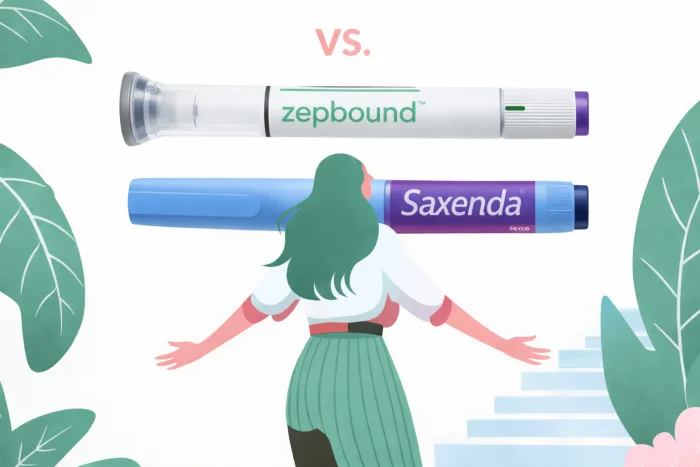
Zepbound vs. Saxenda: Overview
The Bottom Line
At higher doses, Zepbound produces roughly 2-3x more weight loss than Saxenda in clinical trials (results vary by dose and diabetes status—closer to 1.5-2x in some populations). However, Saxenda may still be your best option in certain situations—including step therapy requirements, pediatric use, or insurance mandates.
Saxenda (liraglutide) was one of the first GLP-1 medications approved specifically for weight loss. GLP-1 stands for "glucagon-like peptide-1"—a hormone that helps control hunger and blood sugar. Zepbound (tirzepatide) is a newer medication that works on two hunger-related hormones (GIP and GLP-1) instead of just one, which is why it typically produces better results.
Here's how they compare at a glance:
| Feature | Zepbound | Saxenda |
|---|---|---|
| Active Ingredient | Tirzepatide | Liraglutide |
| How It Works | Works on 2 hormones (GIP + GLP-1) | Works on 1 hormone (GLP-1 only) |
| Dosing | Once weekly injection | Once daily injection |
| Average Weight Loss | 18-22% at 72 weeks[1] | 5-8% at 56 weeks[2] |
| FDA Approval | November 2023[6] | December 2014[7] |
| Age Indication | Adults only[6] | Ages 12+[4] |
| List Price (2026) | ~$1,086/month[5] | ~$1,349/month[5] |
| Manufacturer | Eli Lilly | Novo Nordisk |
For a complete overview of Zepbound, see our Zepbound guide. For all alternatives, see Zepbound alternatives.
WHEN EACH MEDICATION MAKES SENSE
Saxenda vs Zepbound: Which Should You Choose?
Whether you're searching for "Saxenda vs Zepbound" or "Zepbound vs Saxenda," here's the decision framework:
- If maximum weight loss is your goal: Zepbound at higher doses produces roughly 2-3x more weight loss (varies by individual) and requires only weekly dosing
- If you're a teenager (12-17): Saxenda or Wegovy are options—Zepbound isn't approved for pediatric use
- If your insurance requires step therapy: You may need to try Saxenda first before qualifying for Zepbound
- If you prefer daily vs. weekly injections: Some patients prefer Saxenda's daily routine; most prefer Zepbound's weekly convenience
Read on for detailed efficacy data, side effect comparisons, and insurance coverage information.
CLINICAL TRIAL DATA
How They Compare: Efficacy
The most important difference between these medications is how much weight they help you lose. Clinical trials show a dramatic difference:
Zepbound (SURMOUNT Trials)
| Trial | Population | Weight Loss | Duration |
|---|---|---|---|
| SURMOUNT-1 | Obesity without diabetes | 20.9% (15mg dose) | 72 weeks |
| SURMOUNT-2 | Obesity + Type 2 diabetes | 14.7%[8] | 72 weeks |
Source: SURMOUNT clinical trial program[1]
Saxenda (SCALE Trials)
| Trial | Population | Weight Loss | Duration |
|---|---|---|---|
| SCALE Obesity | Adults with obesity | 8% | 56 weeks |
| SCALE Maintenance | Weight maintenance | 6.2% additional[9] | 56 weeks |
Source: SCALE clinical trial program[2]
What This Means
At higher doses, Zepbound produces roughly 2-3 times more weight loss than Saxenda (results vary by dose, diabetes status, and individual response). A 200 lb person might expect to lose approximately 40-45 lbs on Zepbound vs. 16 lbs on Saxenda—though individual results vary widely.
Note on long-term safety: Comparative safety data between tirzepatide and older GLP-1s continue to evolve. While both drug classes have similar GI side effect profiles, rare risks are still being monitored through ongoing post-marketing surveillance.
THE SCIENCE BEHIND THE DIFFERENCE
Why Newer GLP-1s Are Preferred
Zepbound and other newer GLP-1 medications produce better results for several reasons:
Dual receptor action (GIP + GLP-1)
Saxenda works on one hunger hormone (GLP-1). Zepbound works on two hunger hormones (GIP and GLP-1), which produces stronger effects:
- You feel fuller longer – Stronger appetite control means fewer cravings
- Better blood sugar control – Your body uses insulin more effectively
- Your body burns more calories – Even at rest, you're using more energy
Weekly vs. daily dosing
Saxenda requires a daily injection. Zepbound is injected once per week. This:
- Improves adherence (fewer missed doses)
- Provides more consistent drug levels
- Is more convenient for patients
Better tolerability at higher efficacy
Both medications can cause stomach-related side effects like nausea, diarrhea, and constipation. However, Zepbound helps you lose much more weight while having similar side effects to Saxenda—meaning you get better results without necessarily having worse side effects.[3]
The jump from older weight loss medications like Saxenda to newer ones like Zepbound represents a major advancement—similar to how newer diabetes medications work better than older ones.
SITUATIONS WHERE SAXENDA MAKES SENSE
When Saxenda May Still Be Used
Despite Zepbound's superior efficacy, Saxenda remains appropriate in several situations:
Pediatric Patients (Ages 12-17)
Saxenda was the first GLP-1 FDA-approved for adolescents 12 and older (December 2020). Wegovy also received pediatric approval in December 2024. Zepbound is currently only approved for adults.[4]
Step Therapy Requirements
Many insurers require patients to try Saxenda (or other medications) first before approving Zepbound. This is called step therapy—you may need to "fail" Saxenda before getting coverage for newer drugs.
Insurance Mandates
Some insurance plans cover Saxenda but exclude Zepbound entirely. In these cases, Saxenda may be your only covered GLP-1 option for weight loss.
Contraindications to Tirzepatide
If you have a contraindication to tirzepatide (severe GI disease, personal/family history of MTC, MEN2), Saxenda may be safer—though you should discuss all GLP-1 options with your doctor.
Switching from Saxenda to Zepbound
If you've been on Saxenda and want to switch to Zepbound for better results, your doctor can typically transition you directly. You may experience renewed GI side effects during the switch as your body adjusts to the new medication.
WHY INSURERS MAKE YOU TRY SAXENDA FIRST
Saxenda as a Gateway to Zepbound
Many insurers require you to try Saxenda before they'll approve Zepbound. Understanding this "step therapy" requirement can save you months of delays. (Note: Coverage varies significantly by plan—always verify with your specific insurer.)
The Legacy Formulary Advantage
Saxenda was FDA-approved in 2014—before most insurers added weight loss drug exclusions. It's grandfathered onto many formularies that now exclude newer drugs like Zepbound. This makes Saxenda easier to get covered initially, but it also means insurers may require you to "fail" on it first.
Important caveat: On some post-2020 plans, both Saxenda and Zepbound may be excluded entirely due to general weight-loss drug exclusions. Always verify your specific plan's formulary.
Step Therapy Reality
| Insurance Type | Saxenda Access | Zepbound Access | Step Therapy Required? |
|---|---|---|---|
| Pre-2020 Plans | Often covered (grandfathered) | May be excluded | Often yes—Saxenda first |
| Post-2020 Plans | May be excluded | May be excluded | Varies by plan |
| Large Employers | Usually covered | Increasingly covered | Often yes—any prior GLP-1 |
Saxenda's Pediatric Coverage Advantage
Ages 12-17: Saxenda or Wegovy
Both Saxenda (since 2020) and Wegovy (since December 2024) are FDA-approved for weight management in adolescents ages 12-17. Zepbound and Mounjaro remain adult-only (18+). If you're seeking coverage for a teenager, Saxenda has longer formulary history—and some plans specifically cover it for pediatric obesity.
Cost Comparison
| Medication | List Price (2026) | With Coverage + Savings Card* | Cash Pay |
|---|---|---|---|
| Zepbound | ~$1,086/month | As low as $25/month* | $299–$449/month (LillyDirect) |
| Saxenda | ~$1,349/month | As low as $25/month* | ~$1,300/month (often $900-1,100+ with discounts) |
*Savings card pricing for eligible commercially insured patients only. Not available for government insurance (Medicare, Medicaid, Tricare). Eligibility and terms vary.
Key insight: If you're paying cash, Zepbound via LillyDirect ($299–$449/month) is significantly cheaper than Saxenda ($900+/month). But if your insurance requires Saxenda for step therapy, completing that trial may be faster than fighting the requirement.
For detailed coverage information, see our insurance coverage guides and cost guide.
INSURANCE REQUIREMENTS
Step Therapy: Using Saxenda First
Step therapy is when your insurance requires you to try (and "fail") a less expensive or older medication before they'll cover a newer one.
How Step Therapy Works
You Request Zepbound
Your doctor submits a prior authorization request for Zepbound.
Insurer Requires Step Therapy
The insurer denies Zepbound, requiring you first try Saxenda, Contrave, or another medication on their preferred list.
You Try the Required Medication
You take Saxenda for a specified period (commonly 3-6 months, depending on your plan's policy).
Document "Failure"
If you don't achieve adequate results or experience intolerable side effects, this is documented as a "step therapy failure."
Resubmit for Zepbound
Your doctor resubmits the prior authorization, noting the failed step therapy trial.
Appealing Step Therapy Requirements
In some cases, you can appeal step therapy requirements—especially if you have a medical reason why Saxenda wouldn't be appropriate for you (contraindication, prior unsuccessful trial, etc.). Many states have step therapy override laws.
Learn more in our step therapy denial guide.
Your GLP-1 coverage,
denied approved
If your Zepbound was denied due to step therapy requirements, Honest Care can help you appeal.
Denied due to step therapy?
Get Appeal HelpZEPBOUND VS SAXENDA
Frequently Asked Questions
Yes, clinical trials show Zepbound produces significantly more weight loss than Saxenda. Zepbound achieves 18-22% body weight reduction at 72 weeks, compared to Saxenda's 5-8% at 56 weeks—often roughly 2-3 times more in higher-dose trials, though results vary by individual and diabetes status.
Saxenda only activates GLP-1 receptors, while Zepbound activates both GIP and GLP-1 receptors. This dual mechanism provides stronger appetite suppression, better glucose control, and enhanced weight loss. Additionally, Saxenda was developed earlier and represents an older generation of weight loss medication.
Yes, many patients switch from Saxenda to Zepbound for better results. Your doctor can help manage the transition. You may experience renewed GI side effects (nausea, etc.) as your body adjusts to the new medication. Some insurers may require documentation that Saxenda wasn't adequately effective.
This is called step therapy. Insurers use it to control costs by requiring patients to try older or less expensive medications first. You must demonstrate that Saxenda didn't work (not enough weight loss or intolerable side effects) before they'll cover Zepbound. Some states have laws allowing patients to bypass step therapy in certain situations.
Surprisingly, Zepbound's list price ($1,086/month) is lower than Saxenda's ($1,349/month). However, actual out-of-pocket costs depend heavily on your insurance coverage and available savings programs. Both manufacturers offer savings cards that can reduce costs to $25/month for eligible patients with commercial insurance.
YOUR PATH FORWARD
What's Next
Learn More About These Medications
Explore complete guides for coverage, costs, and appeals:
Your GLP-1 coverage,
denied approved
✓ Free Templates✓ Premium Support Available
I was denied coverage for...
Get startedWHAT'S CHANGING
Zepbound vs Saxenda: 2026 Outlook
2026: Saxenda Losing Market Share
As newer GLP-1s like Zepbound and Wegovy show superior efficacy, Saxenda (FDA-approved since 2014) is gradually being replaced on formularies. However, Saxenda may still be preferred by some plans due to its longer track record and potentially lower cost.
Coverage Considerations
- Saxenda: Longer FDA approval history (2014) may mean better coverage on some plans
- Step therapy: Some plans require trying Saxenda before approving Zepbound
- Zepbound: Superior efficacy (20.9% vs ~8% weight loss) may justify coverage even if more expensive
Cash Pay Options
If insurance doesn't cover your preferred option:
- Zepbound via LillyDirect: $299–$449/month (vials or KwikPen)
- Saxenda: ~$1,400/month retail; manufacturer savings available
References
- Jastreboff AM, et al. (2022). "Tirzepatide Once Weekly for the Treatment of Obesity." N Engl J Med. 387(3):205-216. SURMOUNT-1 trial. https://pubmed.ncbi.nlm.nih.gov/35658024/
- Pi-Sunyer X, et al. (2015). "A Randomized, Controlled Trial of 3.0 mg of Liraglutide in Weight Management." N Engl J Med. 373(1):11-22. SCALE trial. https://pubmed.ncbi.nlm.nih.gov/26132939/
- Shi Q, et al. (2024). "Comparative Safety of GLP-1/GIP Co-Agonists vs GLP-1 Receptor Agonists." Diabetes Obes Metab. https://pmc.ncbi.nlm.nih.gov/articles/PMC12357579/
- U.S. Food and Drug Administration. (2020). "FDA approves weight management drug for patients aged 12 and older." https://www.fda.gov/drugs/news-events-human-drugs/fda-approves-weight-management-drug-patients-aged-12-and-older
- GoodRx. (2024). "Saxenda vs. Zepbound: 5 Differences to Know." https://www.goodrx.com/conditions/weight-loss/saxenda-vs-zepbound
- U.S. National Library of Medicine. (2025). "Zepbound (tirzepatide) Label Information." https://dailymed.nlm.nih.gov/dailymed/drugInfo.cfm?setid=c21aadfa-6c9e-4106-b06b-d5c6a8af7bb7
- Novo Nordisk. (2024). "Saxenda (liraglutide) Prescribing Information." https://www.novo-pi.com/saxenda.pdf
- Garvey WT, et al. (2023). "Tirzepatide once weekly for the treatment of obesity in people with type 2 diabetes (SURMOUNT-2)." Lancet. 402(10402):613-626. https://pubmed.ncbi.nlm.nih.gov/37385275/
- Wadden TA, et al. (2013). "Weight maintenance and additional weight loss with liraglutide after low-calorie-diet-induced weight loss." Int J Obes. 37(11):1443-1451. SCALE Maintenance. https://pubmed.ncbi.nlm.nih.gov/23812094/
Last updated October 6, 2026
Disclaimer
The information on this page is for educational and informational purposes only and is not intended as medical advice. Honest Care does not provide medical diagnosis, treatment, or individualized recommendations. Always seek the advice of your physician or other qualified healthcare professional regarding any medical condition or treatment.
While this content has been reviewed for accuracy and balance, new evidence may emerge after publication. Drug availability, indications, and insurance coverage can change over time. Honest Care makes no warranties as to completeness or currentness of the information and is not responsible for decisions made based on this content.