
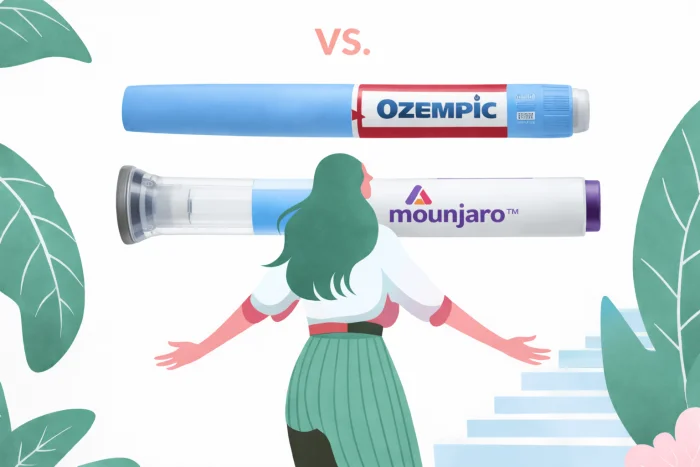
OZEMPIC VS. MOUNJARO
Key Differences at a Glance
Bottom Line
Both Ozempic and Mounjaro are FDA-approved for type 2 diabetes, but many people use them off-label for weight loss. Mounjaro (tirzepatide) typically produces more weight loss (~20-22%) than Ozempic (semaglutide, ~14-15%) because it activates two hormone pathways instead of one.[1][4]
| Feature | Ozempic | Mounjaro |
|---|---|---|
| Active Ingredient | Semaglutide | Tirzepatide |
| Drug Class | GLP-1 receptor agonist | Dual GIP + GLP-1 agonist |
| FDA Approval | Type 2 diabetes (2017)[2] | Type 2 diabetes (2022)[7] |
| Weight Loss Version | Wegovy (same drug, higher doses) | Zepbound (same drug, weight loss label) |
| Avg. Weight Loss | ~14-15% (at max 2mg dose) | ~20-22% (at max 15mg dose) |
| Max Dose | 2 mg/week | 15 mg/week |
| Administration | Weekly injection | Weekly injection |
| Manufacturer | Novo Nordisk | Eli Lilly |
| List Price | ~$1,000/month | ~$1,050/month |
MECHANISM OF ACTION
How They Work
Ozempic (Semaglutide): GLP-1 Receptor Agonist
Ozempic works by mimicking GLP-1, a hormone your body naturally produces after eating. GLP-1 does several things:[2]
- Signals your brain that you're full (reduces appetite)
- Slows stomach emptying (you feel satisfied longer)
- Stimulates insulin release when blood sugar is high
- Reduces glucagon (a hormone that raises blood sugar)
Mounjaro (Tirzepatide): Dual GIP + GLP-1 Agonist
Mounjaro activates two hormone pathways instead of one. In addition to GLP-1 effects, it also activates GIP (glucose-dependent insulinotropic polypeptide):[3]
- All the same GLP-1 benefits as Ozempic
- Enhanced insulin secretion via GIP pathway
- May improve how your body uses fat for energy
- Potentially stronger appetite suppression
Why the Dual Mechanism Matters
The additional GIP activation is why Mounjaro typically produces 5-7% more weight loss than Ozempic. Think of it as having two engines instead of one—both working together to control appetite and blood sugar.
CLINICAL TRIAL DATA
Weight Loss Results
While both medications are approved for diabetes, weight loss data comes from their respective clinical trials:[1][4]
| Metric | Ozempic (2mg) | Mounjaro (15mg) |
|---|---|---|
| Average Weight Loss | ~14-15% | ~20-22% |
| For 200 lb Person | ~28-30 lbs | ~40-44 lbs |
| ≥10% Weight Loss | ~55-60% of patients | ~85-90% of patients |
| ≥20% Weight Loss | ~25-30% of patients | ~55-60% of patients |
| Time to Max Effect | ~68 weeks | ~72 weeks |
Important context: These results are from trials of the weight-loss versions (Wegovy and Zepbound) at their maximum doses. When prescribed for diabetes, doses are often lower, so weight loss may be less dramatic.[4]
Off-Label Use Considerations
If you're using Ozempic or Mounjaro off-label for weight loss (not diabetes), insurance coverage can be more difficult. The weight-loss approved versions—Wegovy and Zepbound—may be easier to get covered for obesity.
TOLERABILITY
Side Effects Comparison
Both medications share similar side effects since they work on the same GLP-1 pathway. Gastrointestinal issues are most common, especially when starting or increasing doses (rates shown are from FDA prescribing information at maximum doses):[2][3]
| Side Effect | Ozempic | Mounjaro |
|---|---|---|
| Nausea | 20% | 18% |
| Diarrhea | 9% | 17% |
| Vomiting | 9% | 9% |
| Constipation | 3% | 7% |
| Injection Site Reactions | <1% | 3% |
| Low Blood Sugar Risk | Low (unless with insulin) | Low (unless with insulin) |
Managing Side Effects
- Start at the lowest dose and increase gradually
- Eat smaller, more frequent meals
- Avoid fatty, greasy, or spicy foods
- Stay hydrated
- Most GI side effects improve after 4-8 weeks
Serious (Rare) Side Effects
Both medications carry warnings for pancreatitis, gallbladder problems, and a theoretical risk of thyroid tumors (seen in rodent studies). Tell your doctor immediately if you experience severe abdominal pain, persistent vomiting, or a lump in your neck.
Who Should NOT Take These Medications
- Personal or family history of medullary thyroid cancer
- Multiple Endocrine Neoplasia syndrome type 2 (MEN 2)
- History of pancreatitis
- Pregnant or planning to become pregnant
- Type 1 diabetes
HOW TO USE
Dosing & Administration
Both medications are self-administered weekly injections using pre-filled pens:
| Week | Ozempic | Mounjaro |
|---|---|---|
| Weeks 1-4 | 0.25 mg | 2.5 mg |
| Weeks 5-8 | 0.5 mg | 5 mg |
| Weeks 9-12 | 1 mg (optional increase) | 7.5 mg (optional) |
| Weeks 13+ | 2 mg (max dose) | 10-15 mg (max dose) |
Injection Sites
Both can be injected in:
- Abdomen (at least 2 inches from belly button)
- Thigh (front or outer area)
- Upper arm (back of arm—may need help)
Storage
| Storage | Ozempic | Mounjaro |
|---|---|---|
| Refrigerated | Until expiration date | Until expiration date |
| Room Temperature | 56 days | 21 days |
Travel Tip
Ozempic is more travel-friendly since it stays stable at room temperature for 56 days vs. just 21 days for Mounjaro. If you travel frequently, this may be a consideration.
AFFORDABILITY
Cost & Insurance Coverage
List Prices (Without Insurance)
| Medication | Monthly Cost | Annual Cost |
|---|---|---|
| Ozempic | ~$1,000 | ~$12,000 |
| Mounjaro | ~$1,050 | ~$12,600 |
Insurance Coverage for Diabetes
When prescribed for type 2 diabetes (the FDA-approved use), both medications typically have good insurance coverage:
- Most commercial plans cover both for diabetes
- Medicare Part D may cover both for diabetes (plan formulary and prior authorization apply)
- Copays typically range from $25-$150/month with insurance
- Prior authorization is often required
Coverage for Weight Loss (Off-Label)
Getting coverage for weight loss is more challenging:
- Commercial insurance: Most plans won't cover off-label weight loss use
- Medicare: Part D explicitly excludes weight loss drugs
- Better options: Ask your doctor about Wegovy or Zepbound—the weight-loss approved versions
Savings Programs
| Program | Ozempic | Mounjaro |
|---|---|---|
| Savings Card | Pay as low as $25/fill | Pay as low as $25/fill |
| Eligibility | Commercial insurance only | Commercial insurance only |
| Patient Assistance | NovoCare PAP (uninsured) | Lilly Cares (uninsured) |
Medicare and weight-loss GLP-1s: the Medicare GLP-1 Bridge
By law, basic Medicare Part D coverage excludes drugs when used for weight loss (some enhanced plans could offer them as supplemental benefits). The Medicare GLP-1 Bridge is a separate, temporary CMS demonstration outside the Part D benefit (July 1, 2026 – December 31, 2027) that covers Wegovy, Foundayo and the Zepbound KwikPen for weight loss for $50 a month, with conditions. GLP-1s may be covered under Part D for other medically accepted uses (e.g. type 2 diabetes, Wegovy for CV risk, Zepbound for OSA), subject to the plan’s formulary, prior authorization and exceptions process.
- Who qualifies: Age 18+ and BMI ≥35; or BMI ≥30 with HFpEF, uncontrolled high blood pressure or CKD stage 3a+; or BMI ≥27 with prediabetes, a prior heart attack or stroke, or symptomatic PAD.
- Who doesn’t: Not eligible if you have type 2 diabetes, moderate-to-severe obstructive sleep apnea, or noncirrhotic MASH with moderate-to-advanced liver fibrosis (F2–F3), or if your Part D plan paid for a GLP-1 for you at any time in 2026.
- Cost: $50 per monthly fill. Does not count toward the Part D deductible or out-of-pocket cap. Extra Help (LIS) does not lower it. Not eligible for the Medicare Prescription Payment Plan. Coupons and discount programs can’t be applied.
- No opt-in needed: Part D plans and pharmacies don’t opt in, and you don’t enroll separately; your prescriber must get prior authorization.
- If it’s denied: No appeals process for a Bridge prior-authorization denial: your prescriber can resubmit with more information (Part D appeal rights for Part D coverage decisions still apply).
Source: CMS, Medicare GLP-1 Bridge · Facts in this box verified October 5, 2026
DECISION GUIDE
Which One Is Right for You?
Consider Mounjaro If:
- Maximum weight loss is your primary goal
- You have type 2 diabetes with significant weight to lose
- You've tried Ozempic and plateaued
- You can tolerate potentially more GI side effects
- Storage flexibility isn't a major concern
Consider Ozempic If:
- You have a sensitive stomach or GI concerns
- Blood sugar control is the primary goal (weight loss secondary)
- You travel frequently (longer room-temp stability)
- It's on your insurance formulary and Mounjaro isn't
- You want a medication with longer real-world safety data (approved 2017)
If Your Goal Is Primarily Weight Loss
Consider asking your doctor about the weight-loss approved versions instead:
- Wegovy (semaglutide 2.4mg) — FDA-approved for obesity
- Zepbound (tirzepatide) — FDA-approved for obesity
These may be easier to get covered by insurance for weight management.
Switching Between Medications
It's possible to switch from Ozempic to Mounjaro (or vice versa) under your doctor's guidance. Many patients who plateau on one medication see renewed results when switching to the other drug class.
OZEMPIC VS MOUNJARO
Frequently Asked Questions
Looking for Weight Loss Medications?
Ozempic and Mounjaro are diabetes drugs. For FDA-approved weight loss:
Your GLP-1 coverage,
denied approved
✓ Free Templates✓ Premium Support Available
I was denied coverage for...
Get startedReferences
- Jastreboff AM, et al. (2022). "Tirzepatide Once Weekly for the Treatment of Obesity." N Engl J Med. 387:205-216. SURMOUNT-1 Trial. NEJM
- Ozempic (semaglutide) Prescribing Information. Novo Nordisk. January 2025. Novo Nordisk
- Mounjaro (tirzepatide) Prescribing Information. Eli Lilly. 2025. Lilly
- Wilding JPH, et al. (2021). "Once-Weekly Semaglutide in Adults with Overweight or Obesity." N Engl J Med. 384:989-1002. STEP 1 Trial. NEJM
- Wilding JPH, et al. (2022). "Weight regain and cardiometabolic effects after withdrawal of semaglutide." Diabetes Obes Metab. 24:1553-1564. STEP 1 Extension. PubMed
- CMS BALANCE Model: Better Approaches to Lifestyle and Nutrition for Comprehensive hEalth. Centers for Medicare & Medicaid Services. December 23, 2025. CMS
- FDA Approves Mounjaro (tirzepatide) for Type 2 Diabetes. FDA News Release. May 13, 2022. FDA
- Aronne LJ, et al. (2024). "Continued treatment with tirzepatide for maintenance of weight reduction in adults with obesity." JAMA. 331(1):38-48. SURMOUNT-4 Trial. PubMed